

 Send Email
 whatsapp


Privacy Curtains are touched often, changed under pressure, and frequently overlooked in infection-control planning. In busy wards, emergency departments, and isolation areas,disposable hospital curtains can help reduce contamination risk while simplifying room turnover for environmental services teams. Their value, however, depends on more than simply swapping fabric for single-use material. Facilities must choose curtains that fit existing tracks, meet fire safety requirements, provide adequate opacity, and align with waste-handling policies. This guide outlines practical installation and maintenance considerations so healthcare teams can improve hygiene, control costs, and keep patient spaces ready for use with fewer workflow disruptions.
Strategic Benefits of Disposable Hospital Curtains
The transition toward single-use clinical infrastructure plays a notable role in modern facility management. By replacing traditional fabric barriers, facilities staff can address stringent hygiene protocols and streamline operational workflows in high-traffic care environments.
Role in Infection Control
Healthcare-Associated Infections (HAIs) pose a significant threat to vulnerable populations and hospital budgets. Traditional fabric partitions frequently act as high-touch fomites; research indicates that a high percentage of reusable privacy curtains can become contaminated with pathogens like methicillin-resistant Staphylococcus aureus (MRSA) or vancomycin-resistant enterococci (VRE) within weeks of laundering. Implementing Single-Use Hospital Curtains helps mitigate this transmission risk. Because these barriers are discarded rather than washed, the risk of cross-contamination between patient admissions is reduced. Furthermore, specific SKUs are treated with active antimicrobial agents intended to inhibit bacterial growth on the curtain surface. However, these treatments are subject to health authority registration, and facilities should not assume all disposable curtains inherently include active antimicrobial properties.
Cost, Hygiene, and Workflow Considerations
Beyond clinical outcomes, environmental services teams must evaluate the total cost of ownership. The logistical burden of removing, transporting, laundering, and reinstalling fabric curtains carries hidden expenses that can accumulate quickly, depending on local commercial laundry rates and labor costs. Conversely, disposable alternatives offer a predictable model with fixed unit costs. However, facilities must factor in clinical waste disposal fees, which can be substantial and regionally variable, potentially skewing the total-cost-of-ownership argument if omitted. Workflow efficiency improves during room turnovers, as environmental services teams can remove and replace a lightweight disposable curtain in a fraction of the time required to maneuver heavy fabric panels. This rapid turnaround supports better bed utilization rates while maintaining consistent hygiene standards.
Specification and Installation
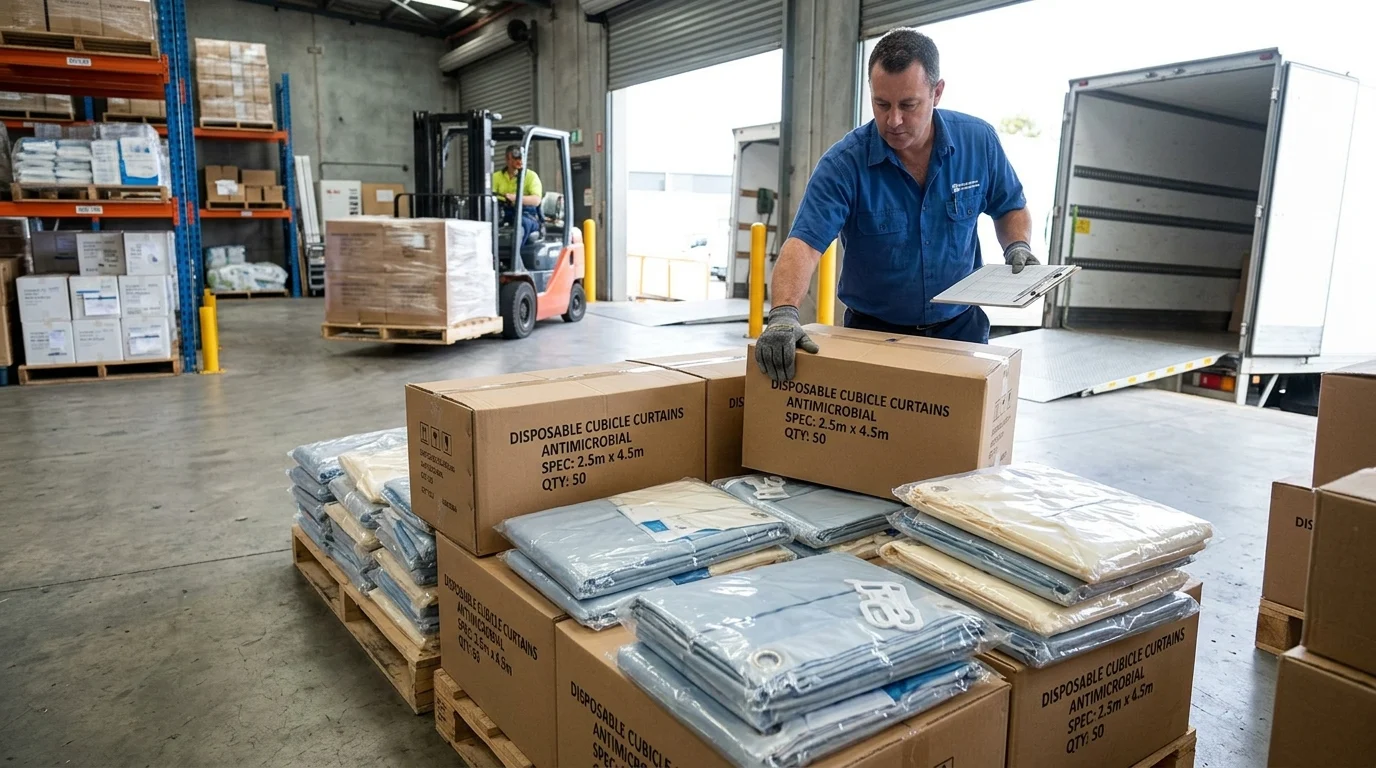
Proper specification and integration into existing infrastructure are critical for maximizing the utility of disposable privacy barriers. Facilities staff should ensure that new procurement lines meet strict safety codes while minimizing the need for modifications to existing ceiling tracks.
Material, Track Compatibility, and Fire Safety
Many modern Medical Curtains are manufactured from non-woven polypropylene. While specific manufacturer designs commonly weigh between 100 and 120 grams per square meter (GSM), general industry standards prioritize structural integrity and opacity. Disposable curtains achieve adequate opacity and draping via pleating despite this lower GSM, providing comparable structural coverage to heavier 250–300 GSM fabrics. A critical specification is fire retardancy; curtains must comply with local jurisdictional codes and international fire safety standards, such as NFPA 701 in the United States or BS 5867 Part 2 Type C in the United Kingdom. To facilitate adoption, many of these curtains are designed with eyelets or integrated hook systems intended for standard C-track and I-track profiles. However, facilities should verify compatibility and assess legacy systems—such as J-tracks or wire loops—as these may require specialized adapters or alternative hook designs.
| Specification | Traditional Fabric Curtains | Disposable Polypropylene Curtains |
|---|---|---|
| Material Weight | 250 - 300 GSM | Commonly 100 - 120 GSM (pleating ensures opacity) |
| Fire Safety | Requires re-treatment after washing | Treated for flame retardancy (e.g., NFPA 701) |
| Track Compatibility | Custom hooks often required | Universal eyelets / hooks (verify legacy fit like J-tracks) |
| Environmental Impact | High laundry water and chemical usage | Eliminates laundry water use, but generates large volumes of non-recyclable biohazardous plastic waste |
Installation Steps to Reduce Downtime and Misfit Panels
Efficient installation minimizes ward disruption and prevents privacy breaches caused by ill-fitting panels. To ensure proper fit and function, environmental services staff should follow a standardized, step-by-step protocol:
- Track Measurement: Calculate the track length and add a width allowance—commonly 10% to 20% per manufacturer specifications. For example, a 5-meter ceiling track requires a curtain width of at least 5.5 to 6 meters to ensure adequate overlap and closure.
- Hardware Verification: Inspect the track for smooth operation, paying special attention to how corners or track transitions might affect the curtain's glide.
- Glide Attachment: Utilize pre-pleated designs that unfold uniformly. Fast-fit hook systems often allow a single worker to snap the curtain into standard roller glides without specialized tools.
- Clearance and Draft Checks: Achieve a consistent drop length, typically leaving a clearance of 10 to 15 centimeters from the floor to prevent contamination from mops and floor buffers. Note that exact floor clearance distances may be governed by local jurisdictional fire and safety codes. If curtain gusts or drafting from HVAC systems are an issue, verify whether weighted hems or tack systems are needed to keep the barrier securely in place.
- Troubleshooting Misfit Panels: If a panel sags or gaps appear, check for missing glides or incompatible hook lengths. Adjusting the hook placement or adding supplementary glides can often resolve uneven draping on legacy tracks.
Maintenance, Replacement, and Procurement
Maintaining strict hygiene protocols requires a proactive approach to curtain lifecycle management. Establishing clear guidelines for auditing, replacing, and procuring these barriers ensures continuous compliance with health department regulations while optimizing inventory levels.
Replacement Schedules for Cleanliness and Compliance
Unlike conventional textiles that rely on centralized laundry schedules, disposable barriers demand ward-level replacement schedules. Local infection-prevention policies vary widely and should ultimately dictate the timeline (e.g., fixed calendar intervals for general wards versus higher frequencies for ICUs). To assist with these audits, many disposable curtains feature clearly printed labels where staff can record the installation date.
To distinguish routine inspection from immediate replacement triggers, environmental services staff can use the following concise audit checklist:
- Routine Inspection (Leave in Place): Curtain is within its designated calendar lifespan; no visible stains; intact pleats and hooks; date label is clearly marked.
Key Takeaways
- Replace disposable hospital curtains after discharge, visible contamination, isolation use, or the facility’s approved change interval to reduce cross-contamination risk.
- Verify fire-retardancy compliance, such as NFPA 701 or BS 5867 Part 2 Type C, before approving disposable curtains for clinical use.
- Check track compatibility, curtain dimensions, and hanging hardware before purchase to avoid installation delays on existing C-track or I-track systems.
- Include clinical waste disposal fees in total-cost calculations, because these costs can vary significantly by region and affect procurement decisions.
- Do not assume antimicrobial protection is included; confirm manufacturer documentation and regulatory approvals for any antimicrobial claims.
Frequently Asked Questions
How often should disposable hospital curtains be replaced?
Replace them according to facility policy, manufacturer guidance, and risk level—commonly after patient discharge, visible contamination, isolation use, or a defined time interval in high-traffic areas.
Do all disposable hospital curtains have antimicrobial protection?
No. Some products are treated with antimicrobial agents, but not all disposable curtains include this feature. Facilities should verify product documentation, regulatory registration, and approved claims before relying on antimicrobial performance.
Are disposable curtains compatible with existing hospital tracks?
Many disposable cubicle curtains are designed for standard C-track or I-track systems using eyelets, hooks, or integrated hanging designs. Always confirm dimensions, attachment type, and track compatibility before procurement.
What fire safety standards should hospital curtains meet?
Curtains should comply with applicable local fire codes and recognized standards such as NFPA 701 in the United States or BS 5867 Part 2 Type C in the United Kingdom.
Can disposable curtains reduce room turnover time?
Yes. Lightweight disposable curtains are typically faster to remove and replace than laundered fabric panels, helping environmental services teams support faster cleaning cycles and better bed availability.