

 Send Email
 whatsapp


In controlled environments, a mop is not a basic cleaning tool—it is part of the contamination control system. Floors, walls, and ceilings can collect particles, residues, and microorganisms that may be resuspended into critical airflow or transferred by operators. Choosing the right cleanroom mopping system affects product quality, batch yield, and regulatory readiness in pharmaceutical, biotechnology, and semiconductor facilities. This article explains how low-lint materials, validated particle performance, sterilization compatibility, and disinfectant resistance influence mop selection. It also compares common mop formats and highlights what facility teams should verify before introducing any cleaning tool into classified zones.
Why Cleanroom Mop Selection Matters
Maintaining the integrity of controlled environments relies heavily on rigorous surface disinfection protocols. Floors, walls, and ceilings endure high mechanical stress and operator interaction, demanding purpose-built tools to mitigate contamination. Selecting the appropriate tools for floor disinfection is a critical decision that directly impacts yield rates, product safety, and regulatory compliance in pharmaceutical, semiconductor, and biotechnology facilities.
Facility managers must evaluate materials and designs to ensure their cleaning apparatus meets the precise demands of classified zones without inadvertently introducing the very contamination they are designed to remove.
What Defines a Cleanroom Mop
A cleanroom mop is engineered to capture micro-contaminants without introducing foreign matter. Unlike commercial janitorial tools made from cotton or standard rayon, which can shed significant fibers during use, these implements utilize continuous-filament polyester or microfiber blends. The manufacturing process often occurs within a cleanroom, ensuring the product is free from ambient dust and biological agents before packaging.
To qualify for use in ISO Class 4 or stricter environments, a mop head intended for classified zones must demonstrate ultra-low particle generation. As an illustrative example, under Helmke Drum testing (IEST-RP-CC004.3), some premium mops emit fewer than 1,200 particles (≥0.5 µm) per minute per item. Regional standards vary—such as EU GMP Annex 1 for aseptic processing and ISO 14644 for general classification—so facilities must ensure local compliance. Furthermore, materials intended for aseptic environments must withstand sterilization without degrading, such as gamma irradiation (typically 25 to 40 kGy) or repeated steam autoclave cycles (e.g., 121°C for 30 minutes). These specific test values, gamma doses, and autoclave cycle limits are illustrative, vendor-specific parameters rather than universal constants.
Which Contamination Risks Mops Help Control
Sub-optimal floor disinfection introduces severe operational risks, primarily through the resuspension of settled particulates. Walking across an improperly cleaned floor can resuspend settled microscopic particles, propelling them into the unidirectional airflow and jeopardizing manufacturing zones. This dynamic resuspension is a primary vector for contamination events that lead to batch rejections and facility downtime.
Mops mitigate both viable bioburden in aseptic compounding and non-viable particulate matter in microelectronics fabrication. By utilizing capillary structures, microfiber mops trap and remove contaminants down to 0.1 microns. This mechanical action is crucial for reducing cross-contamination risks, removing endotoxins, and extracting sticky chemical residues left behind by disinfectants, ensuring surfaces remain chemically compatible and compliant. However, facilities must explicitly verify disinfectant compatibility, as aggressive quaternary ammonium or phenolic disinfectants can degrade microfiber, polyester, or PVA mop materials over time.
Cleanroom Mop Types and Specifications
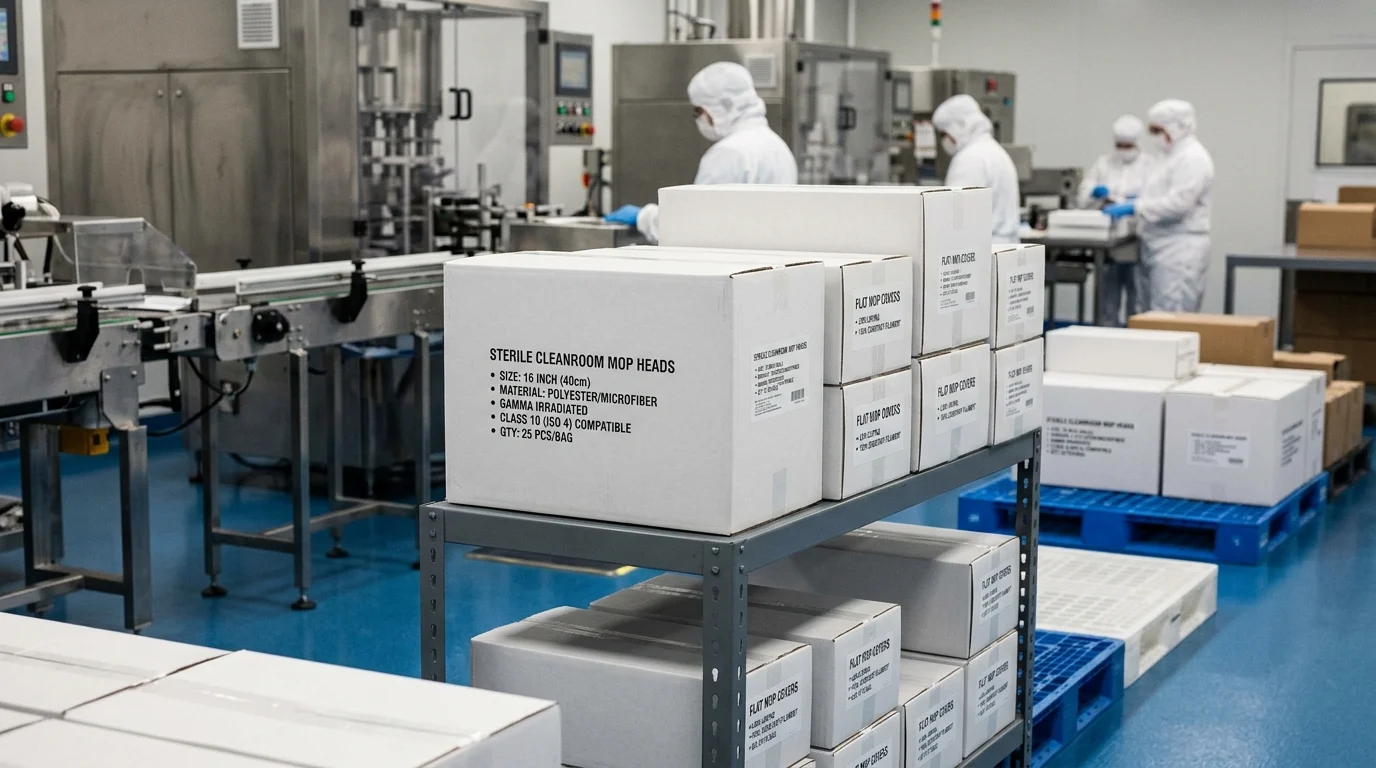
The architecture of a facility's contamination control program dictates the specific tooling required for daily operations. Facilities must evaluate their unique spatial constraints, anticipated soil loads, and sterilization capabilities when assessing hardware and textiles from a qualified supplier. The correct selection optimizes the efficacy of disinfectants and reduces the labor hours required to achieve compliance.
How Disposable, Reusable, Flat, String, and Sponge Mops Compare
The market offers distinct configurations tailored to specific operational demands and geometric constraints. Flat mops provide consistent contact pressure, making them the industry standard for applying uniform layers of disinfectants on expansive walls and floors. String or tube mops excel in areas with high fluid volumes, complex geometries, gratings, and uneven surfaces; however, they are generally discouraged in the highest-grade cleanrooms (e.g., ISO 3–4), as their compatibility depends heavily on the specific application, disinfectant, and standard operating procedures (SOPs). Meanwhile, sponge mops, often formulated from polyvinyl alcohol (PVA), offer superior liquid retention for rapid fluid recovery during large spills.
| Mop Type | Textile / Material Format | Optimal Application | Typical ISO Compatibility | Typical Service Life |
|---|---|---|---|---|
| Flat Microfiber | Continuous Filament / Blended | Disinfectant application, smooth surfaces | ISO 3 - 8 | 1 shift (Disposable) or 50+ washes (Reusable) |
| Tube/String | Looped Polyester | Heavy spills, perforated gratings, corners | ISO 5 - 8 | 30 - 50 autoclave cycles |
| PVA Sponge | Polyvinyl Alcohol Foam | Fluid recovery, wiping dry, gross cleaning | ISO 6 - 8 | Varies by chemical degradation rate |
Note: ISO compatibility is not an inherent product rating; actual suitability and replacement cycles depend heavily on validation, disinfectant compatibility, mechanical wear, and specific facility SOPs.
Which Specifications Matter Most
Procurement engineers must scrutinize technical specifications beyond basic material composition and dimensions. Absorption capacity is a paramount metric. As an illustrative example of vendor-specific values, a microfiber mop headmight demonstrate an absorption capacity exceeding 300% to 400% of its dry weight. This retention rate ensures the efficient, even distribution of disinfecting agents across large surface areas—often cited as 15 to 20 square meters per Mop Head—without requiring constant returns to the wringer bucket, thereby minimizing operator fatigue and motion-generated particles.
Additionally, fabric weight, measured in grams per square meter (GSM), indicates durability and mechanical strength. A typical illustrative GSM range of 120 to 150 provides sufficient structural integrity to prevent tearing on micro-abrasions. Equally important is the Non-Volatile Residue (NVR) specification. Example thresholds for premium mops might require maintaining an NVR level below 0.05 mg/g in deionized water and isopropyl alcohol extractions, ensuring they do not leach plasticizers, silicones, or unreacted polymers. As with sterilization thresholds, specific absorption ratios, GSM requirements, and NVR limits are highly vendor- and application-dependent, and must be verified against internal facility requirements.
How to Source and Validate Cleanroom Mops
Establishing a reliable, transparent supply chain and a rigorous validation protocol is essential for long-term contamination control and audit readiness. Partnering with a qualified wholesale distributor ensures consistent lot-to-lot traceability and prevents inventory shortages that could halt production lines. Instead of relying solely on marketing claims, procurement teams should implement concrete supplier-qualification criteria, including ISO certifications, third-party audit reports, and sample qualification protocols.
Key Takeaways
- Select low-lint mop materials such as continuous-filament polyester or microfiber to reduce particle shedding in ISO-classified areas.
- Verify particle-generation data, sterilization compatibility, and vendor documentation before approving a mop for critical cleanroom zones.
- Use cleanroom mops to control both viable bioburden and non-viable particulates that can be resuspended by operator traffic.
- Confirm disinfectant compatibility because quaternary ammonium, phenolic, or other aggressive chemistries may shorten mop life or reduce performance.
- Match disposable, reusable, flat, string, or sponge mop formats to the facility layout, soil load, sterilization process, and compliance requirements.
Frequently Asked Questions
Why are standard janitorial mops unsuitable for cleanrooms?
Cotton, rayon, and conventional mop materials can shed fibers and particles during use. Cleanroom mops use low-lint materials such as continuous-filament polyester or microfiber to reduce particle release in classified areas.
What materials are commonly used in cleanroom mop heads?
Common materials include microfiber blends, polyester, PVA, and other low-shedding synthetics. The right choice depends on ISO class, disinfectant chemistry, sterilization method, and whether the mop is disposable or reusable.
How do cleanroom mops help control contamination?
They remove settled particles, viable bioburden, endotoxins, and chemical residues from floors, walls, and ceilings. Proper mopping also reduces particle resuspension caused by operator movement in controlled environments.
Can cleanroom mops be sterilized?
Many cleanroom mops are designed for gamma irradiation or steam autoclaving, but limits vary by product. Facilities should verify vendor data for sterilization dose, cycle temperature, and material durability before use.
Are microfiber mops compatible with all disinfectants?
No. Some aggressive quaternary ammonium or phenolic disinfectants may degrade microfiber, polyester, or PVA over time. Always confirm chemical compatibility with the mop supplier and facility validation requirements.