

 Send Email
 whatsapp


Bulk purchasing cleanroom mops is not just a supply-chain decision; it is a contamination-control decision with direct implications for yield, sterility, compliance, and operating cost. The right mop must align with your ISO classification, cleaning chemistry, particle-control targets, and the specific risks of your industry—whether that means low ionic contamination for semiconductor fabrication or microbial control for pharmaceutical production. This guide breaks down the most important factors procurement teams and facility managers should evaluate before committing to volume orders, from fiber shedding and non-volatile residue to ESD properties, material compatibility, supplier controls, and lifecycle value.
Start Cleanroom Mop Selection with Contamination Risk
Factor 1: Contamination Risk Assessment. Buying a cleanroom floor mop inventory requires evaluating the specific contamination risks inherent to your facility's operations. Rather than relying on a generic overview, facility managers should conduct a baseline risk assessment before purchasing:
- Map highest-risk zones: Identify critical areas where contamination directly impacts product viability.
- Baseline current particle counts: Establish existing particulate and microbial levels to measure mop efficacy.
- Evaluate ESD properties: For microelectronics and semiconductor cleanrooms, ensure mops and handles support proper electrostatic discharge (ESD) grounding to prevent static damage.
- Identify chemical compatibility constraints: Document all disinfectants used to ensure mop materials will not degrade (see Factor 5 for material specifics).
When executing bulk purchases, failing to properly assess these risk factors can lead to significant yield losses in sensitive manufacturing environments, product recalls, and regulatory penalties.
Define Cleanroom Mop Requirements by ISO Class
Factor 2: ISO Class and Industry Compatibility. The foremost criterion in selecting bulk cleaning supplies is adherence to the facility's specific ISO 14644-1 classification and industry requirements. For critical environments such as ISO Class 3 and 4 semiconductor fabrication plants, procurement must focus exclusively on ultra-low particulate materials and ionic contaminants. These applications demand continuous-filament, double-knit polyester mops that undergo proprietary laundering. While standards like IEST-RP-CC004 provide testing frameworks (such as the Helmke Drum test), acceptable particle thresholds are highly facility-specific.
Conversely, pharmaceutical facilities must evaluate bioburden, endotoxin limits, and disinfectant efficacy, prioritizing sterility over pure particulate counts. ISO Class 5 through 8 environments offer slightly more flexibility. In these zones, blended materials or advanced non-woven formats may be acceptable, provided they maintain consistent particulate emission profiles strictly below the threshold required for the specific operational zone.
Compare Mop Types by Particle, Fiber, and Residue Risk
Factor 3: Particle and Fiber Shedding.Evaluating the physical construction of the mop is essential to mitigating fiber shedding. Traditional String Mops are highly susceptible to snagging and continuous fiber release, making them generally not recommended for any environment stricter than ISO Class 7.Flat mops and sponge configurations present a significantly lower risk profile than string mops due to their uniform surface contact, sealed edges, and superior structural integrity under friction, though sponges are typically still reserved for ISO 6 or 7 zones compared to ultra-clean polyester.
Factor 4: Chemical Residue Limits. Non-volatile residue (NVR) is another critical metric, particularly in microelectronics and optics manufacturing where ionic contaminants are heavily monitored. High-grade mops must demonstrate exceptionally low NVR levels when extracted with deionized water or isopropyl alcohol, with exact acceptable limits defined by the manufacturer's specific process tolerances. Exceeding these limits can leave microscopic films on work surfaces, which may interfere with delicate photolithography processes or compromise sterile compounding environments.
Evaluate Key Specifications and Supplier Controls
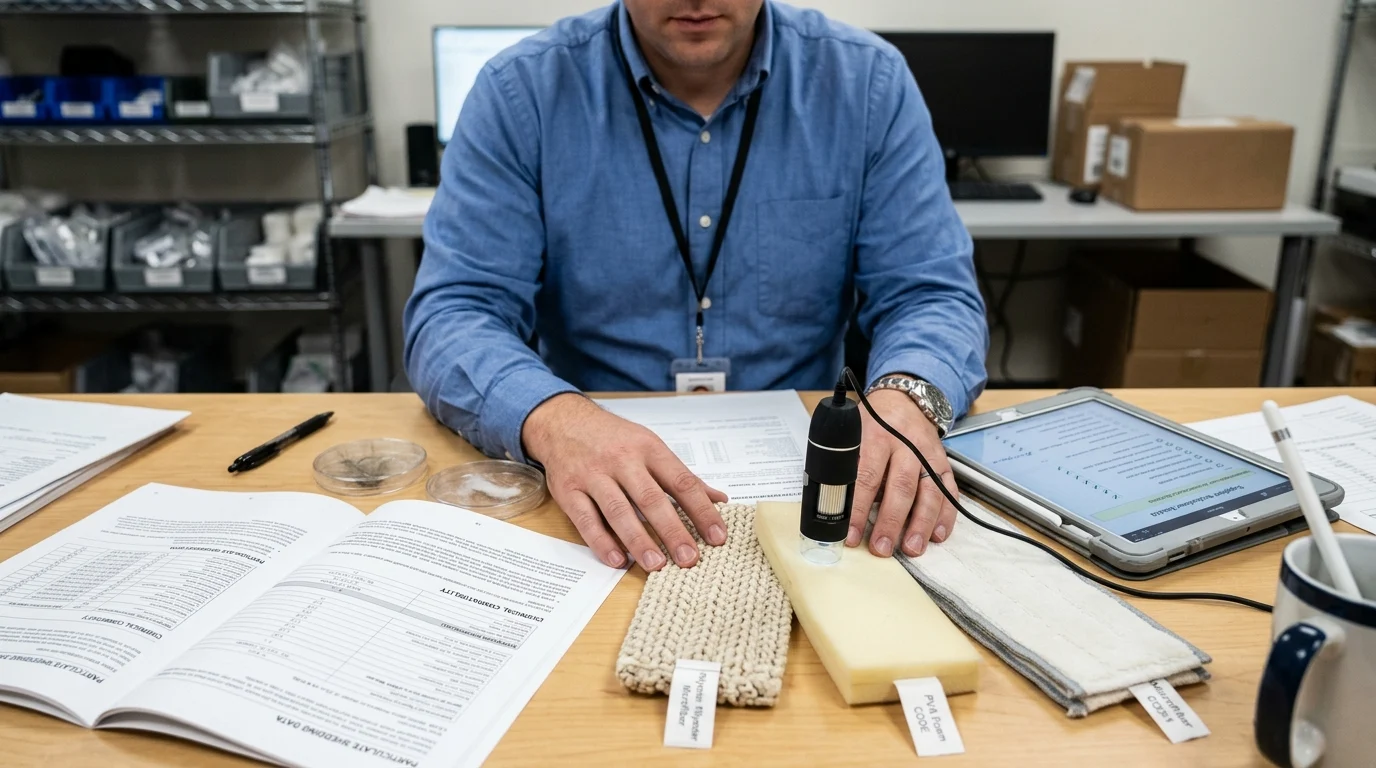
Moving beyond initial contamination risk, procurement teams must deeply scrutinize the physical specifications of the mop and the operational maturity of the manufacturer. Relying on a vetted, highly compliant cleanroom mop supplier ensures that the raw materials and the final assembled products meet stringent, repeatable quality standards across thousands of units in a bulk order.
Assess Mop Head Materials, Absorbency, and Compatibility
Factor 5: Material and Absorbency. Material selection directly dictates both cleaning efficacy and chemical compatibility. A standard cleanroom polyester mop provides excellent resistance to aggressive disinfectants, including 70/30 isopropyl alcohol, sodium hypochlorite, and quaternary ammonium compounds, without degrading or releasing unwanted byproducts over time. Absorbency is equally critical for operational efficiency; premium mops should demonstrate a high fluid capacity tailored to the facility's needs to ensure the efficient application of disinfectants and optimized surface contact times.
Factor 6: Handle Compatibility and Autoclavability. Buyers must clearly distinguish between replaceable mop covers (pads) and integrated mop heads. The specific cleanroom mop head attachment mechanism—such as slip-on pockets, Velcro, or clamp systems—directly dictates handle compatibility. Ensuring mop heads securely fit existing ergonomic handles prevents operational inefficiencies and safety hazards. Furthermore, hardware used in sterile environments must withstand repeated autoclave cycles without warping, rusting, or shedding particulate matter, making stainless steel or specialized plastics necessary considerations.
Factor 7: Disposable vs. Launderable Lifecycle. Procurement should conduct a comprehensive lifecycle cost analysis comparing disposable versus reusable (launderable) mops. While reusable mops may offer lower upfront material costs, buyers must account for hidden lifecycle variables such as validation labor, water and energy usage, tracking-system overhead, and eventual disposal fees. Conversely, single-use disposable mops eliminate cross-contamination risks and laundering overhead, though they require consistent supply chain reliability.
Note: The table below provides general material guidelines. Actual mop suitability depends heavily on end-user validated cleaning processes, specific disinfectant chemistry, and facility-specific risk assessments rather than mapping materials rigidly to ISO classes.
| Material Type | Particle Shedding Risk | Absorbency Capacity | General ISO Compatibility |
|---|---|---|---|
| Double-Knit Polyester | Very Low | Moderate | ISO 3 – 4 |
| Microfiber Blend | Low | High | ISO 5 – 6 |
| Polyurethane Sponge | Low | Very High | ISO 6 – 7 |
Verify Documentation, Lot Traceability, and Quality Controls
Factor 8: Quality Controls and Traceability. Bulk purchasing necessitates stringent quality assurance protocols to prevent entire shipments from failing facility compliance audits. Buyers must require Certificates of Conformance (CoC) and Certificates of Analysis (CoA) for every single production lot. For sterile applications, these documents must validate sterilization doses. As an illustrative example, gamma irradiation often requires 25 to 40 kGy to achieve a Sterility Assurance Level (SAL) of 10^-6, though exact doses depend entirely on the supplier's validated process.
Crucially, pharmaceutical and microelectronics buyers cannot rely solely on supplier CoAs. End-user validation and qualification requirements—such as site-specific cleaning validation, disinfectant efficacy testing, and material compatibility studies—are mandatory to ensure the product performs safely in the actual operational environment. Furthermore, lot traceability is a non-negotiable requirement for GMP-compliant facilities.
Compare Bulk Pricing, Logistics, and Procurement Fit
Evaluating a cleanroom mop extends beyond particle shedding and absorbency metrics; procurement teams must rigorously assess financial and logistical viability to ensure uninterrupted supply chain operations.
Calculate Landed Cost, Shelf Life, and Storage Needs
Securing a competitive bulk rate requires analyzing the total cost of ownership rather than focusing solely on the supplier's unit price.
- Landed Cost: Calculate the final acquisition cost by combining the ex-works price, international freight, customs duties, and insurance. Because mop heads often possess high volumetric weight, shipping costs can significantly impact the bottom line. Ensure accurate HS code classification (often under textile articles) to forecast import tariffs accurately.
- Shelf Life Limitations: Sterile cleanroom mop variants processed via gamma irradiation typically carry a validated shelf life of 24 to 36 months. Procurement managers must align bulk order volumes with actual facility burn rates to prevent costly inventory expiration.
- Storage Requirements: Bulk inventory demands dedicated, climate-controlled warehousing. Extreme fluctuations in temperature and humidity can degrade synthetic materials like polyester or microfiber blends, compromising their structural integrity before they enter the cleanroom.
Use a Practical Buyer Decision Process
Implementing a structured procurement workflow mitigates operational risks when switching suppliers or scaling up order volumes. Facilities should adopt a phased approach to sourcing:
- Supplier Auditing: Verify the manufacturer’s ISO 9001 quality management certification and demand documented traceability for all raw materials.
- Sample Validation: Before committing to a bulk contract, test a sample batch of the proposed cleanroom mop in the active controlled environment. This step confirms physical compatibility with existing mop hardware and validates chemical resistance against standard disinfectants, such as 70% Isopropyl Alcohol (IPA).
- Pilot Purchasing: Execute a smaller, initial purchase order to evaluate the vendor’s lead times, packaging integrity (e.g., double-bagging standards), and logistical reliability.
- Strategic Scheduling: Once the product and vendor are validated, structure annual purchase agreements with staggered delivery schedules. This strategy balances the financial benefits of bulk pricing discounts against the physical limitations of facility storage space.
Key Takeaways
- Begin every bulk cleanroom mop purchase with a contamination risk assessment that maps critical zones, particle baselines, ESD needs, and chemical compatibility requirements.
- Match mop materials and construction to the facility’s ISO 14644-1 class, with ISO Class 3 and 4 areas requiring ultra-low particulate options such as cleanroom-laundered polyester.
- Avoid traditional string mops in stricter cleanrooms because their higher snagging and fiber-shedding risk can compromise ISO Class 7 or cleaner environments.
- Evaluate non-volatile residue limits, especially in microelectronics, optics, and sterile processing, where microscopic films can disrupt sensitive operations.
- Select flat mop or sealed-edge designs where low particle release, consistent surface contact, and structural integrity under friction are required.
Frequently Asked Questions
What type of cleanroom mop is best for ISO Class 3 or 4 environments?
ISO Class 3 or 4 environments typically require ultra-low-lint, continuous-filament polyester mops, often double-knit and cleanroom-laundered to control particles, fibers, and ionic contamination.
Are traditional string mops suitable for cleanrooms?
Traditional string mops are generally not recommended for stricter cleanrooms because they can snag, shed fibers, and release particles. They are usually unsuitable for environments cleaner than ISO Class 7.
Why is chemical compatibility important when buying cleanroom mops in bulk?
Mops must tolerate the disinfectants and cleaning agents used in your facility. Incompatible materials can degrade, shed particles, release residues, or reduce cleaning effectiveness.
What is NVR in cleanroom mop selection?
NVR stands for non-volatile residue. Low NVR is critical in microelectronics, optics, and sterile environments because residues can leave microscopic films that affect processes or cleanliness.
Should pharmaceutical and semiconductor cleanrooms use the same mop specifications?
Not always. Semiconductor facilities often prioritize particle, fiber, ESD, and ionic control, while pharmaceutical facilities focus more on sterility, bioburden, endotoxin limits, and disinfectant performance.