

 Send Email
 whatsapp


Cleanroom Mop Solutions for Sterile Manufacturing

Maintaining cleanliness in sterile manufacturing is crucial for preventing contamination. Contamination incidents can lead to significant regulatory actions, as evidenced by recent FDA warning letters citing deficiencies in contamination control. Effective cleanroom mop solutions, includingcleanroom mops for laboratory and cleanroom mops for healthcare, play a vital role in maintaining hygiene. High-quality options, such as OEM cleanroom mops and disposable microfiber mops for cleanroom use, significantly reduce microbial presence, enhancing overall cleanliness. Additionally, cleanroom mops for electronics are essential for ensuring that sensitive equipment remains uncontaminated.
Key Takeaways
- Choose the right type of cleanroom mop based on your needs. Disposable mops are convenient for quick tasks, while Reusable Mops offer long-term cost savings and sustainability.
- Utilize Microfiber Mops for superior cleaning. They can capture up to 98% of bacteria, making them ideal for maintaining sterile environments.
- Implement best practices for cleaning, such as mopping from high to low and establishing a regular cleaning schedule. This helps minimize contamination and ensures compliance with industry standards.
Types of Cleanroom Mops
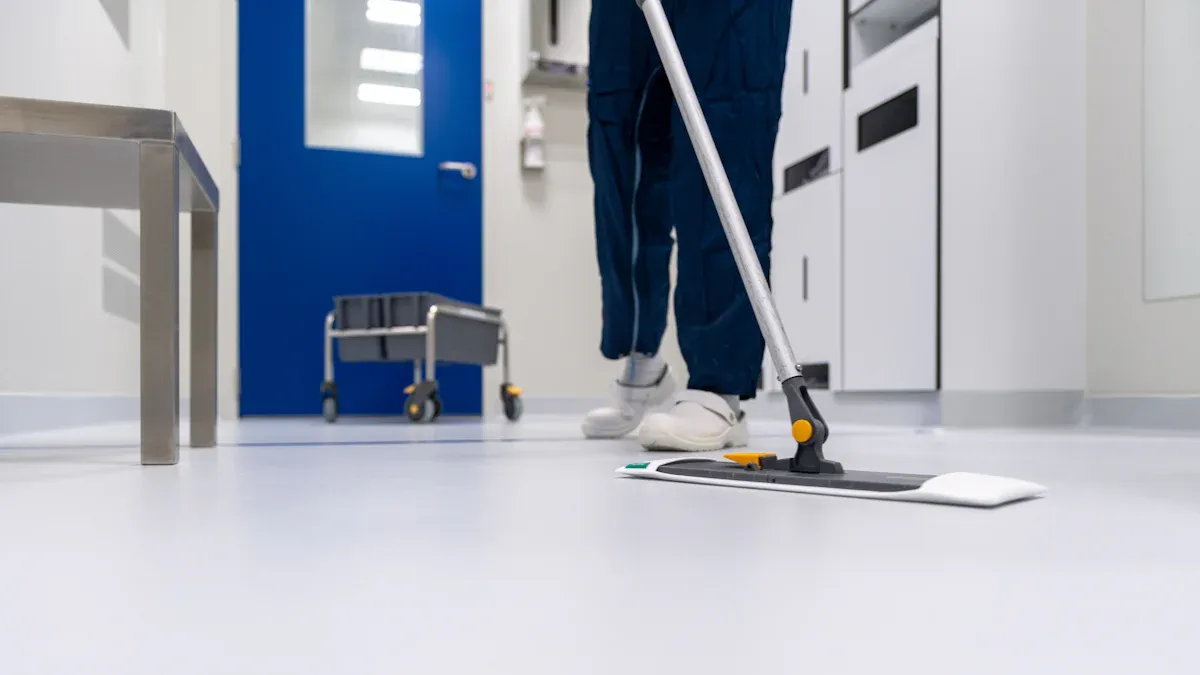
Disposable Cleanroom Mops
Disposable cleanroom mops offer a convenient solution for maintaining sterile environments. These mops are designed for single-use, which significantly reduces the risk of cross-contamination. Their ease of use makes them ideal for quick cleaning tasks in critical areas.
Pros of Disposable Mops:
- Designed for quick and easy cleaning.
- Lower risk of spreading germs.
- Saves time as no maintenance is needed.
However, disposable mops also come with some drawbacks. They can lead to higher long-term costs due to the need for frequent replacements. Additionally, their single-use nature contributes to landfill waste, raising environmental concerns.
Reusable Cleanroom Mops
Reusable cleanroom mops present a more sustainable option for sterile manufacturing facilities. Although they require a higher initial investment, their cost-effectiveness increases over time. Reusable mops can be washed and sterilized, making them suitable for multiple uses.
| Cost Factor / Cleanroom Class | Reusable Mops Characteristics | Disposable Mops Characteristics |
|---|---|---|
| Initial Cost | Higher upfront investment | Lower upfront cost |
| Recurring Material Costs | Lower over time | Higher recurring expenses |
| Validation Expenses | 3-5 times higher | Lower validation burden |
| Storage Requirements | Efficient bulk storage | Requires more space and inventory management |
| Training | Requires comprehensive training | Less intensive training |
In high-volume operations, reusable mops become cost-effective after a certain period, particularly in higher ISO classes. They also reduce environmental impact, making them a responsible choice for organizations committed to sustainability.
Microfiber Cleanroom Mops
Microfiber cleanroom mops are specifically engineered for sterile environments. Their unique properties allow them to capture contaminants effectively while minimizing particle generation. Microfiber mops can remove up to 98% of bacteria using only water, a stark contrast to traditional mops, which typically achieve only about 30%.
| Mop Type | Percentage of Dirt and Bacteria Removed |
|---|---|
| Microfiber Mop | 95% to 98% |
| Traditional Mop | Approximately 68% |
Microfiber mops are compatible with various disinfectants and often feature ergonomic designs. Their low-linting materials help maintain contamination control, making them ideal for sensitive areas like laboratories and manufacturing facilities.
Key Features of Cleanroom Mops
Material Composition
The material composition of cleanroom mops significantly influences their effectiveness in maintaining sterile environments. Various materials offer distinct properties that enhance contamination control. The following table outlines common materials used in cleanroom mop construction and their respective properties:
| Material Type | Properties |
|---|---|
| Knitted Polyester | Very low linting, good thermal resistance, high strength, minimal particle shedding. |
| Nonwoven Fabrics | Low-linting characteristics, ideal for preventing contamination. |
| Micropolyester | Excellent absorbency and particle capture, ensuring effective cleaning. |
| Foam-wrapped materials | Used in specific mop head designs for enhanced cleaning efficiency. |
| Cellulose sponge | Also utilized in specific mop head designs, providing good absorbency. |
| Mop Frames | Constructed from lightweight, non-shedding materials like anodized aluminum or static-dissipative plastic. |
| Mop Types | Single-use mops offer pre-validated cleanliness and sterility; reusable mops require stringent laundering validation. |
Selecting the right material is crucial for ensuring that cleanroom mops do not contribute to contamination. For instance, knitted polyester and micropolyester are preferred for their low particle generation rates and high absorbency.
Mop Design
The design of cleanroom mops plays a vital role in their effectiveness and usability. Key design features include:
- Lightweight Construction: Lightweight mop designs, especially those made from microfiber, reduce staff fatigue. This design eliminates the need for heavy buckets and strenuous wringing, allowing for more efficient cleaning.
- Ergonomic Features: “Z” handle designs help reduce stress on wrists, arms, shoulders, and lower back, promoting ergonomic use. This design minimizes unnecessary movements, enhancing efficiency and reducing operator-borne contamination.
- Low-Linting Materials: Cleanroom mops utilize low-linting, non-shedding materials like microfiber and polyester. These materials are engineered for chemical resistance against disinfectants such as isopropyl alcohol, hydrogen peroxide, and sodium hypochlorite.
Innovative mop designs incorporate continuous-filament polyester or tightly knitted microfiber, ensuring they meet strict airborne particle concentration standards. These features contribute to effective cleaning while maintaining the integrity of sterile environments.
Compatibility with Cleaning Solutions
Compatibility with various cleaning solutions is essential for cleanroom mops. Different disinfectants require specific mop materials to ensure effective cleaning without degradation. The following table summarizes the compatibility of mop materials with common disinfectants used in sterile manufacturing:
| Disinfectant Type | Mop Material Type | Compatibility Details |
|---|---|---|
| Alcohol-heavy protocols (70% IPA) | All types | Excellent compatibility; choose based on other factors. |
| Polyester, melt-blown nonwoven | Best long-term durability. | |
| Microfiber, foam | Handle IPA well but may degrade faster under mechanical stress. | |
| Peroxide-based sporicidal rotation | Polyester sealed-edge | Stable across 100+ cycles at 6% H₂O₂. |
| Microfiber | Suitable if peroxide concentration ≤3% and cycle life expectations are modest. | |
| Foam-core | Degrades faster; limit to ≤3% peroxide or specify single-use. | |
| Bleach (sodium hypochlorite) | Polypropylene melt-blown nonwoven | Best chemical resistance but is single-use. |
| Polyester | Tolerates 500–1000 ppm across 100+ cycles; higher concentrations cause yellowing. | |
| Microfiber | Degrades quickly under bleach; avoid for >1000 ppm protocols. | |
| Foam-core | Limited to ≤500 ppm or single-use. | |
| Quaternary ammonium compounds (quats) | All types | Compatible; choose based on ISO class and TCO rather than chemical resistance. |
| Multi-disinfectant rotation | Polyester sealed-edge | Handles broadest chemical rotation without degradation. |
| Microfiber | Acceptable if bleach is low-concentration or infrequent. | |
| Foam-core, melt-blown nonwoven | Work as single-use consumables but at a higher cost. |
Proper material selection ensures that cleanroom mops perform effectively without degrading or interfering with cleaning protocols. This compatibility is crucial for maintaining the integrity of sterile environments.
Best Practices for Cleanroom Mop Use
Proper Mopping Techniques
Effective mopping techniques are essential for minimizing contamination in sterile environments. Here are some recommended practices:
- Use presaturated cleanroom wipes to enhance contamination removal.
- Clean from the highest to the lowest point to prevent recontamination.
- Mop walls and ceilings with a cleanroom mop, ensuring the mop head remains adequately wet.
Follow these steps for optimal results:
- Dry Mopping: Start with a dry mop to collect loose dust and particles.
- Wet Mopping: Use a clean mop and bucket with a prepared cleaning solution, beginning from the farthest corner and moving toward the exit.
- Rinsing and Drying: Rinse the floor with a fresh solution if necessary, allowing it to dry completely before re-entry.
Frequency of Cleaning
Establishing a regular cleaning schedule is vital for maintaining sterile conditions. The following table outlines recommended cleaning frequencies:
| Frequency | Task Description |
|---|---|
| Daily | Use a damp mop on floors before shifts and vacuum to dry. |
| Vacuum all walls using a HEPA filter vacuum. | |
| Wash and wipe all windows and pass-throughs dry. | |
| Wipe down all work areas at the end of every shift. | |
| Weekly | Mop floors with a cleanroom-specific detergent and distilled water. |
| Wipe walls with a damp sponge and distilled water, then vacuum dry. |
Training for Staff
Proper training for staff is crucial for effective cleanroom mop use. Training programs should cover:
- Cleanroom standards and behavior.
- Cleaning and disinfection protocols.
- Equipment use, including mops and bucket systems.
Hands-on training and continuous learning are essential components. Tailoring training to the specific cleanroom classification and industry enhances its effectiveness. Experienced instructors should lead sessions to ensure staff understand the importance of proper techniques and contamination control methods.
Maintenance and Care of Cleanroom Mops
Cleaning and Sanitizing Mops
Proper cleaning and sanitizing of cleanroom mops are essential for maintaining sterile environments. Effective sanitizing agents include:
- Cleanroom-Grade Sporicide: Crucial for controlling microbial contamination.
- Cleanroom-Grade Quaternary Ammonium: Effective for non-food-contact surfaces.
- Cleanroom-Grade Hydrogen Peroxide: Evaporates with minimal residue, ensuring non-toxicity.
Regularly using these agents helps ensure that mops remain effective in preventing contamination.
Storage Recommendations
Storing cleanroom mops correctly prevents contamination and extends their lifespan. Follow these guidelines:
- Thorough Cleaning After Each Use: Clean mops meticulously to remove residual particles.
- Drying Is Crucial: Ensure mop heads are completely dry before storage to prevent microbial growth.
- Dedicated Storage Areas: Store mops in designated, contamination-free areas to maintain cleanliness.
Additionally, segregate mop types and label them based on their specific applications to avoid cross-contamination.
Lifespan and Replacement
The lifespan of cleanroom mops typically ranges from 18 to 24 months for low-volume operations with weekly autoclaving. Factors influencing replacement schedules include:
- Volume of Operations: Higher usage leads to faster wear.
- Cleaning Protocols: More rigorous cleaning may necessitate more frequent replacements.
- Cost Considerations: Different mop systems have varying economic impacts.
Manufacturers determine replacement needs by monitoring indicators such as fiber degradation, loss of absorbency, and autoclave cycle limits. Regular assessments ensure that mops meet sterility standards and maintain effective cleaning capabilities.
Choosing the right cleanroom mop solutions is vital for maintaining sterile environments. Facilities must prioritize validated cleaning systems that comply with regulatory standards, such as EU GMP Annex 1 and ISO 14644-5. Key features include selecting sealed-edge polyester mop heads for low particle generation and ensuring proper mop frame design.
To maintain sterile conditions, facilities should adopt best practices such as:
- Creating a controlled environment with HEPA filters.
- Implementing a three-bucket system to prevent re-contamination.
- Utilizing high-quality distilled water for cleaning.
By following these guidelines, organizations can significantly enhance their contamination control efforts and ensure compliance with industry standards.
FAQ
What are the benefits of using microfiber cleanroom mops?
Microfiber mops capture up to 98% of bacteria and dust, enhancing cleanliness while minimizing particle generation in sterile environments.
How often should cleanroom mops be replaced?
Replace cleanroom mops every 18 to 24 months, depending on usage and cleaning protocols, to maintain effective contamination control.
Can disposable mops be used in all cleanroom environments?
Disposable mops are suitable for many cleanroom environments but may not be cost-effective for high-volume operations. Evaluate specific needs before use.