

 Send Email
 whatsapp


Disposable Hospital Curtains for Safety and Convenience

Disposable hospital curtains significantly enhance patient safety and streamline healthcare operations. Studies indicate 20-40% of healthcare-associated infections (HAIs) link to contaminated surfaces. These disposable cubicle curtains directly reduce cross-contamination risks. A hospital privacy curtain ensures patient dignity. Disposable curtains hospital facilities adopt offer immediate benefits. They provide a clear solution for improved patient care and operational convenience.
Key Takeaways
- Disposable hospital curtains help stop the spread of germs. They reduce infections in hospitals.
- These curtains are easy to change. They save hospitals money on cleaning and upkeep.
- Disposable curtains make patient areas look clean. This helps patients feel safer and more comfortable.
Enhancing Infection Control with Disposable Cubicle Curtains

Preventing Cross-Contamination Risks
Healthcare facilities face a constant challenge in preventing the spread of infections. Traditional reusable privacy curtains often become reservoirs for harmful pathogens. Studies show these curtains can harbor dangerous microorganisms. For example, Clostridioides difficile, Methicillin-resistant Staphylococcus aureus (MRSA), Vancomycin-resistant Enterococcus (VRE), and Acinetobacter baumannii commonly contaminate them. Viruses like Influenza and SARS-CoV-2 also persist on these surfaces. Fungi such as Aspergillus and Penicillium further contribute to the microbial load.
Contamination levels on traditional curtains increase rapidly. By 14 days, curtains show significant contamination. Almost all curtains exceed 2.5 CFU/cm² by day 21. One study found 87.5% of test curtains grew MRSA by day 14. This highlights the urgent need for frequent intervention. Many institutions only change curtains when visibly soiled or after a patient with a multi-drug resistant organism discharges. This practice contrasts sharply with research suggesting earlier intervention. Disposable cubicle curtains offer a direct solution. Healthcare staff remove and replace them quickly, preventing the accumulation and transfer of these dangerous pathogens. This proactive approach significantly reduces the risk of cross-contamination between patients and staff.
Advanced Materials for Hygiene
Modern disposable hospital curtains utilize advanced materials designed to actively combat microbial growth. These materials often feature integrated antimicrobial properties. Commercial hospital privacy curtains with these properties demonstrate a log 3 (99.9%) reduction against various bacteria, viruses, and fungi in standard laboratory tests (ISO 20743).
One effective component is Quaternary Ammonium Chlorides (QACs). Curtains embedded with QACs show significant reductions in microbial burdens. A clinical study found QAC-equipped curtains reduced total microbial burden by 93% compared to standard curtains. Combining QACs with polyorganosiloxane further enhances efficacy. This combination extended the time to first contamination from five weeks (for standard curtains) to over 19 weeks.
Scientific studies confirm the efficacy of these advanced materials. Researchers applied a metal-free quaternary ammonium-based coating to hospital curtains. This coating demonstrated excellent antibacterial activity. It achieved a 98–100% CFU reduction against Staphylococcus aureus, Pseudomonas aeruginosa, and Acinetobacter baumanii within four hours. The functionalized curtain also showed significant antiviral activity. It achieved over 99% viral reduction against murine hepatitis virus (MHV) when tested according to ISO-18184. This antibacterial and antiviral efficacy remained even after six months of aging and durability testing, indicating long-term functionality. These advanced materials make disposable cubicle curtains a powerful tool in infection control.
Meeting Healthcare Compliance Standards
Healthcare facilities must adhere to strict infection control standards set by regulatory bodies. The Centers for Disease Control and Prevention (CDC) recommends cleaning walls, blinds, and window curtains in patient-care areas when visibly dusty or soiled. This guidance applies directly to hospital curtains. The Joint Commission's 2024 Infection Control Chapter, specifically Standard IC.07.01.01, addresses the cleaning and maintenance of hospital curtains. This standard references the CDC's guidance for cleaning surfaces near the patient. It also specifies that privacy curtains, being porous, cannot be disinfected. Facilities must exchange them for clean ones according to established protocols.
Disposable hospital curtains simplify compliance with these rigorous standards. They eliminate the need for complex cleaning and disinfection processes for fabric curtains. Recommended guidelines for curtain replacement include several scenarios. Facilities should replace curtains after any patient with an infectious diagnosis discharges. They should also replace them on a scheduled basis, such as every three to six months. Immediate replacement is necessary if the curtain becomes visibly soiled. During outbreaks or heightened risk periods, facilities must also change curtains promptly. For isolation cases, staff change out the curtains and bag the soiled ones. Disposable curtains make these frequent changes practical and cost-effective, ensuring facilities consistently meet infection prevention requirements.
Operational Efficiency and Convenience of Disposable Hospital Curtains
Rapid Replacement and Installation
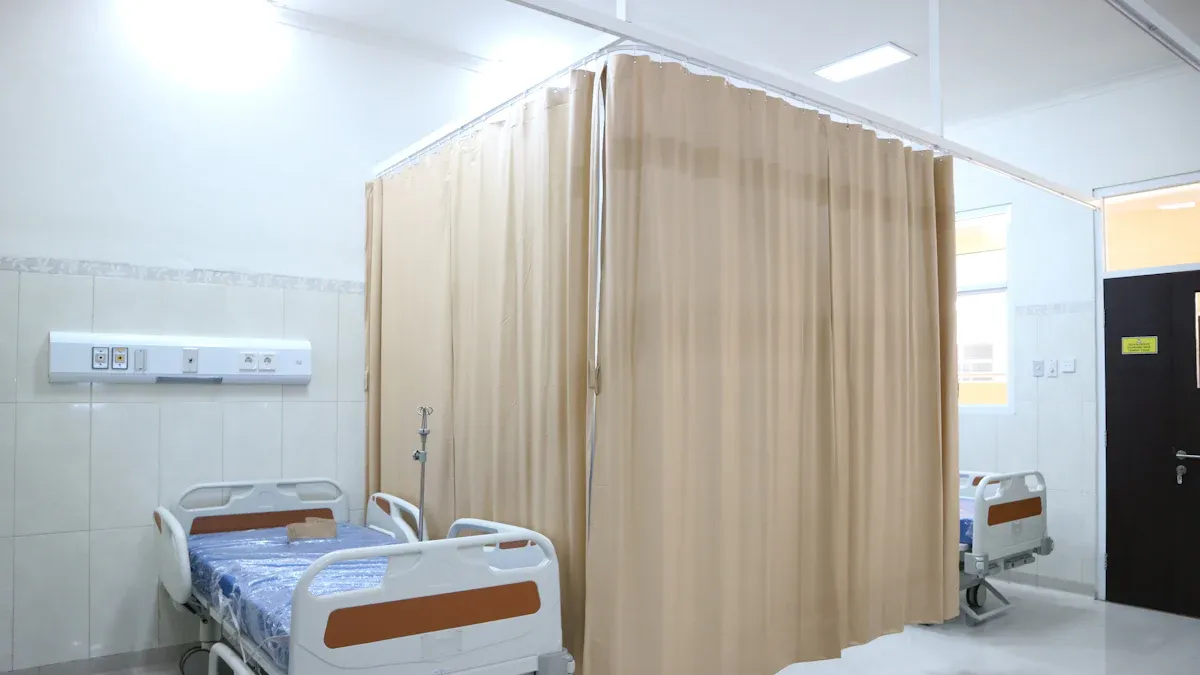
Disposable hospital curtains offer significant advantages in terms of speed and ease of replacement. Healthcare staff can quickly remove and install these curtains. This process takes only minutes, unlike traditional curtains that require more time and effort for detachment, laundering, and re-hanging. Many disposable systems feature hookless designs or lightweight panels. These designs make handling much simpler for environmental services (EVS) staff.
Rapid replacement of disposable curtains provides important ergonomic benefits for healthcare staff. Systems with hookless or lightweight panel designs are easier to manage. A study showed that using antimicrobial disposable curtains reduced physical strain and increased safety for EVS staff. The decreased need for frequent heavy lifting or hauling of laundry bags directly improves ergonomics. It also enhances job satisfaction among staff members. This efficiency ensures patient areas remain clean and ready for use without significant delays.
Eliminating Laundry and Maintenance Costs
Traditional reusable curtains incur substantial ongoing costs. These costs include laundry services, repairs, and inventory management. Hospitals must pay for water, energy, detergents, and labor to clean reusable curtains regularly. They also need to track curtains and replace damaged ones. Disposable curtains eliminate these expenses entirely. Once a disposable curtain reaches the end of its use, staff simply discard it. This removes the need for complex laundry logistics and associated labor.
A hospital facility can achieve an average annual cost saving of approximately $25,000 by eliminating laundry services for reusable curtains. This figure represents the annual cost associated with maintaining reusable curtains. It includes their laundry and other related services. Beyond direct laundry costs, facilities save on inventory management, storage space, and the administrative burden of scheduling cleaning services. This shift allows healthcare facilities to reallocate resources to other critical areas of patient care.
Improving Patient Experience and Privacy
A clean and well-maintained environment significantly impacts patient perception and satisfaction. Crisp, clean privacy curtains positively influence patients. They foster trust and confidence in their care. Disposable curtains always present a fresh, pristine appearance. This creates a visually appealing environment that boosts patient satisfaction. Patients feel more comfortable and secure in a space that looks and feels clean.
Disposable curtains significantly enhance infection control. They minimize hospital-acquired infections (HAIs). Unlike traditional fabric curtains that can harbor pathogens, disposable cubicle curtains offer a hygienic, single-use solution. Their single-use nature and tracking systems reduce cross-contamination risks. Each new curtain provides a fresh, sterile barrier. This is especially important in isolation scenarios. Clean privacy curtains help reduce the risk of cross-contamination for both patients and staff. A clean and well-maintained healthcare space, supported by disposable curtains, contributes to patient comfort, trust, and confidence in the quality of care. This leads to positive patient experiences and better outcomes.
Practical Implementation and Cost-Effectiveness of Disposable Curtains
Selecting the Right Disposable Cubicle Curtains
Choosing the correct disposable cubicle curtains involves several considerations. Facilities must prioritize fire retardancy. Curtains should meet international standards like NFPA 701 and BS 5867 Part 2 Types B & C 2008. Manufacturers often use 100% recyclable polypropylene for durability. This material is lightweight. A mesh top design is also crucial. It allows light to pass through and ensures sprinklers or exit signs remain unobstructed during a fire. Regarding installation, various hanging systems exist. Fantex® Curtains offer C-Fit, E-Fit, J-Fit, and U-Fit hook types. These integrate with existing hospital tracks. ICP Medical's Rapid Refresh® System also installs on existing tracks. It uses rod-set adaptors for different ceiling heights. Facilities should check track compatibility with ceilings, lighting, and HVAC layouts.
Staff Training for Seamless Integration
Effective integration of disposable curtain systems requires proper staff training. Hospitals should select curtains with antimicrobial properties and eco-friendly materials. This maximizes infection control and sustainability. Consulting with reputable suppliers is also important. These suppliers can provide tailored solutions. Most importantly, staff training and education are essential. Hospital staff must understand the proper use and disposal of disposable curtains. This maintains infection control standards. Regular monitoring of curtain usage and condition ensures high hygiene levels and compliance with protocols.
Analyzing Long-Term Financial Benefits
Evaluating the long-term financial benefits of disposable curtains requires a comprehensive view. Disposable curtains offer initial cost savings. However, their effectiveness in infection control necessitates frequent changes. This can lead to higher long-term costs due to ongoing replacement and increased waste disposal fees. Reusable curtains can reduce long-term costs and waste. Their overall cost-effectiveness depends on laundering frequency and facility policy. Reusable isolation gowns and surgical linens have shown up to 50% cost savings for hospitals. Reusable underpads and OR linens consistently outperform single-use versions in cost per use. Reusable textiles also lead to lower landfill and medical waste disposal fees.
Disposable hospital curtains are essential for modern healthcare safety and efficiency. They provide a clear solution for improved patient care and operational convenience. Embracing this innovation benefits patients, staff, and healthcare facilities. It ensures a safer, more hygienic environment for everyone. 🏥
FAQ
Are disposable hospital curtains truly cost-effective?
Disposable curtains reduce laundry and maintenance costs. Frequent replacement can increase overall spending. Facilities must compare long-term costs with reusable options. 💰
How do disposable curtains enhance infection control?
Staff replace them quickly. This prevents pathogen accumulation. Many curtains feature antimicrobial materials. They significantly reduce cross-contamination risks. 🦠
What materials are disposable hospital curtains made from?
Manufacturers often use 100% recyclable polypropylene. This material is lightweight and durable. Some include antimicrobial agents for added hygiene. ♻️
