

 Send Email
 whatsapp


How Disposable Hospital Curtains Create a Safer Healing Environment

Disposable hospital curtains significantly enhance patient safety and privacy. By minimizing bacterial contamination, these Medical Curtains help reduce infection risks. Research indicates that hospitals utilizingdisposable cubicle curtains see a 30% reduction in infection rates. This statistic underscores the effectiveness of these hospital room curtains in maintaining a hygienic environment and promoting overall healthcare standards.
Key Takeaways
- Disposable hospital curtains significantly reduce infection rates by minimizing bacterial contamination, leading to safer healing environments.
- These curtains enhance patient privacy and comfort, creating a more secure atmosphere that can improve overall patient satisfaction and recovery.
- Adopting Disposable curtains simplifies cleaning protocols and operational workflows, allowing healthcare facilities to focus more on patient care.
Infection Risks of Traditional Hospital Curtains

Bacterial Contamination
Traditional hospital curtains pose significant infection risks due to their propensity for bacterial contamination. Studies reveal alarming statistics regarding the prevalence of harmful bacteria on these curtains. For instance, research by Trillis et al. (2008) identified various bacteria commonly found on traditional hospital curtains, as shown in the table below:
| Study Reference | Bacteria Found | Prevalence |
|---|---|---|
| Trillis, et al. (2008) | VRE | 42% |
| Trillis, et al. (2008) | MRSA | 22% |
| Trillis, et al. (2008) | C. difficile | 4% |
| Ohl, et al. (2012) | MRSA | 21% |
| Ohl, et al. (2012) | VRE | 42% |
| Ohl, et al. (2012) | Contamination within one week | 92% |
The data indicates that 92% of traditional hospital curtains become contaminated with pathogenic bacteria within just one week of use. Furthermore, 87% of these curtains show contamination with MRSA after 14 days. Such high rates of contamination highlight the urgent need for improved hygiene practices in healthcare settings.
Cross-Contamination Issues
Cross-contamination represents another critical concern associated with traditional hospital curtains. A longitudinal study found that 12 out of 13 curtains (92 percent) showed contamination within one week. Additionally, 41 of 43 curtains (95 percent) demonstrated contamination at least once, with 21 percent testing positive for MRSA and 42 percent for VRE.
"The longitudinal study design allowed us to demonstrate that, in the majority of cases, contamination occurs rapidly after curtains are placed in the hospital environment. Additionally, healthcare workers and patients frequently touch privacy curtains, promoting the transfer of bacteria to curtains, which can then be transmitted to patients."
These findings underscore the role of hospital curtains in facilitating the spread of infections within healthcare facilities. The frequent contact with these curtains by both patients and healthcare workers increases the likelihood of cross-contamination, thereby compromising patient safety.
Benefits of Disposable Hospital Curtains
Reduced Infection Rates
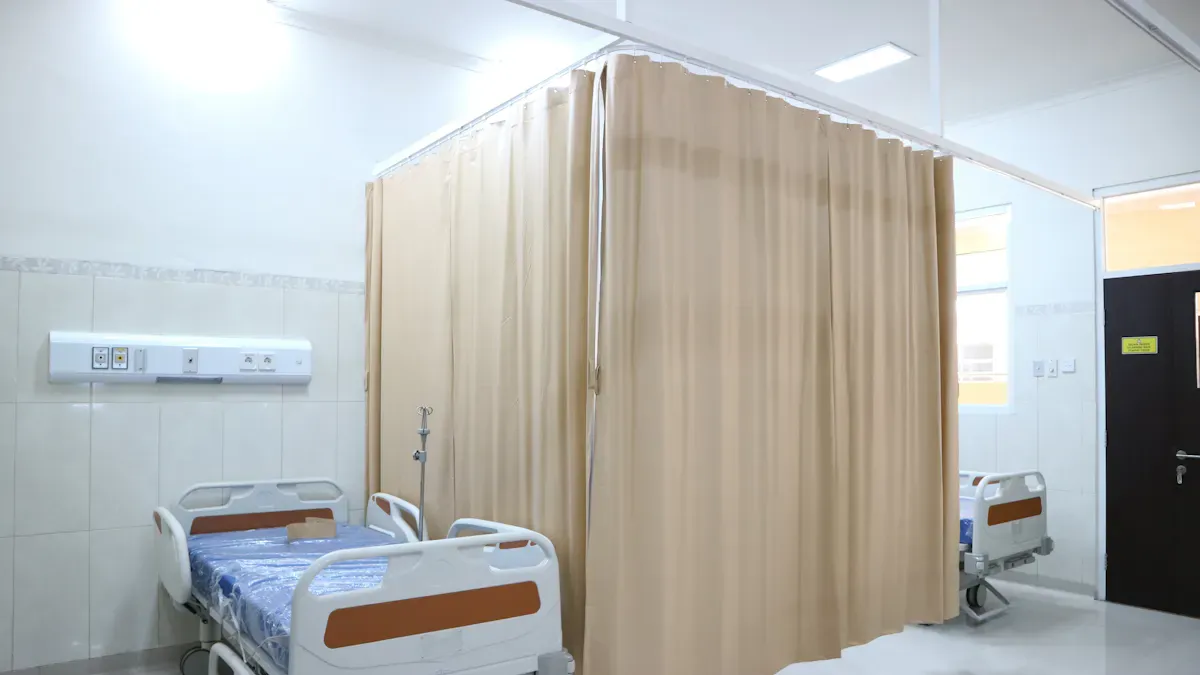
Disposable hospital curtains significantly lower infection rates in healthcare settings. Their design for single use minimizes the risk of cross-contamination, a common issue with traditional curtains. Research indicates that disposable curtains maintain a near-zero contamination rate after 20 weeks, while traditional curtains show a staggering 92% contamination rate within just one week. This stark contrast highlights the effectiveness of disposable options in infection control.
Healthcare organizations recognize the importance of these curtains. The Centers for Disease Control and Prevention (CDC) recommends replacing disposable hospital curtains at least once a month. Immediate replacement is necessary when curtains become visibly soiled or contaminated. This proactive approach ensures that healthcare facilities uphold high hygiene standards, ultimately protecting patient safety.
Enhanced Hygiene Standards
The use of disposable hospital curtains aligns with strict infection control guidelines. These curtains often feature advanced antimicrobial properties, such as those found in Endurocide® Antimicrobial Plus, which actively trap and kill pathogens. This innovation significantly reduces the risk of infections, providing a cleaner environment for each new patient.
Healthcare facilities benefit from simplified cleaning protocols when using disposable curtains. Unlike traditional curtains that require extensive laundering, disposable options can be replaced quickly, eliminating contaminated surfaces. This efficiency not only enhances infection control but also improves operational workflows within hospitals.
In addition to infection prevention, disposable curtains signal a commitment to patient safety. They help improve the reputation of healthcare facilities within the medical community. Regular inspections of curtains for signs of wear or contamination further support hygiene efforts. By adopting disposable hospital curtains, healthcare providers demonstrate their dedication to maintaining optimal hygiene standards.
| Product Name | Features |
|---|---|
| ESUN SMS/SMMS Non-Perforated White Surgical Drapes | Disposable, Non-Perforated |
| Esun Antimicrobial Privacy Disposable Hospital Curtains | Antimicrobial properties |
| Esun Permanent Antibacterial & Flame Retardant Hospital Curtain | Antibacterial, Flame Retardant |
| ESUN Perforated Non-Woven Anti-microbial Hospital Curtain | Anti-microbial, Perforated |
Improving Patient Comfort and Privacy with Hospital Curtains
Increased Sense of Security
Disposable hospital curtains create individual spaces for patients, significantly reducing anxiety and enhancing their sense of security during recovery. Unlike traditional curtains, which may fail to provide adequate privacy, disposable options ensure that patients feel shielded from the surrounding environment. This increased privacy fosters a more comfortable atmosphere, allowing patients to focus on healing rather than feeling exposed.
Better Patient Experience
The introduction of disposable hospital curtains has led to notable improvements in patient satisfaction scores. Quick changeouts of these curtains in under two minutes allow healthcare staff to prioritize patient care. A neat and professional appearance enhances the overall environment, contributing to a clean healthcare space that fosters comfort, trust, and confidence in the quality of care.
Moreover, respecting personal space through effective curtain systems leads to higher patient satisfaction and can even accelerate recovery. A well-maintained curtain system provides a sense of security, which is crucial for better patient outcomes. The combination of privacy and cleanliness creates a positive experience that patients value during their hospital stay.
- Patient privacy significantly enhances comfort and overall hospital experience.
- A clean healthcare space fosters trust and confidence in care quality.
- A well-maintained curtain system contributes to better patient outcomes.
By investing in disposable hospital curtains, healthcare facilities not only improve hygiene but also enhance the overall patient experience, making recovery more pleasant and effective.
Operational Advantages of Disposable Curtains
Cost-Effectiveness
Disposable hospital curtains offer significant cost advantages over traditional reusable options. While the annual cost of maintaining reusable curtains can reach approximately $25,000, the total cost for disposable curtains is around $66,000. Despite the higher upfront costs, disposable curtains save time and resources by eliminating laundering needs. This efficiency allows healthcare facilities to allocate funds to other critical areas.
- Key Cost Benefits:
- Reduced labor costs due to no laundering requirements.
- Lower maintenance complexity, allowing staff to focus on patient care.
- Improved workflow, as staff can change curtains quickly, often in under two minutes.
Simplified Cleaning Protocols
The use of disposable curtains simplifies cleaning protocols significantly. Unlike traditional curtains, which require regular laundering and adherence to strict cleaning protocols, disposable curtains can be replaced immediately after use. This process eliminates contaminated surfaces and reduces infection risks.
| Curtain Type | Cleaning Requirements | Maintenance Requirements |
|---|---|---|
| Disposable Curtains | No laundering required; simply disposed of after use. | No maintenance needed; replaced as needed. |
| Reusable Curtains | Requires regular laundering and adherence to cleaning protocols to ensure hygiene. | Must be inspected regularly and replaced as part of a management plan. |
By adopting disposable hospital curtains, healthcare facilities enhance operational efficiency and ensure a safer environment for patients and staff. The quick-change systems facilitate efficient replacements, especially in areas with high patient turnover. This operational advantage not only improves infection control but also supports better patient outcomes.
In summary, disposable hospital curtains significantly enhance patient safety and hygiene. Research shows that these curtains lower the risk of hospital-acquired infections, which is critical for maintaining high standards of patient care. Their operational efficiencies and financial benefits make them a valuable investment for healthcare facilities aiming to improve their environments.
FAQ
What are disposable hospital curtains made of?
Disposable hospital curtains typically consist of non-woven fabric, which is lightweight, durable, and designed for single-use to enhance hygiene.
How often should disposable curtains be replaced?
Healthcare facilities should replace disposable curtains after each patient use or when visibly soiled to maintain optimal hygiene standards.
Do disposable curtains provide privacy?
Yes, disposable hospital curtains effectively create private spaces for patients, enhancing their comfort and sense of security during their hospital stay.