

 Send Email
 whatsapp


Introduction
Reducing cross-contamination on floors requires more than routine cleaning, especially in healthcare, laboratories, and controlled production spaces. A microfiber disposable mop pad is designed for single-use application, helping facilities capture soil and microorganisms while avoiding the transfer risks associated with reused textiles. This article explains how these pads are built, why their fiber structure improves pickup and containment, and where they fit within infection control and cleanroom protocols. It also sets up the practical considerations behind material choice, workflow efficiency, and compliance, so readers can better evaluate whether single-use microfiber systems meet their environmental hygiene goals.
Strategic Role of Microfiber Disposable Mop Pads
Infection control protocols in modern healthcare and controlled manufacturing environments increasingly prioritize the absolute elimination of cross-contamination vectors. The transition from traditional laundering systems to single-use cleaning protocols represents a critical operational shift aimed at securing high-risk environments. Floor care, historically a vulnerability in environmental services due to the potential for pathogen redistribution, has been revolutionized by the introduction of engineered synthetic textiles designed for single-shift utilization.
By discarding the textile after cleaning a single patient room or controlled zone, facilities eradicate the risk of surviving bio-burden being transferred to adjacent areas. This strategic adoption not only streamlines environmental service workflows but also aligns with stringent regulatory guidelines targeting healthcare-associated infections (HAIs) and cleanroom particulate limits.
How facilities define microfiber disposable mop pads
The fundamental architecture of a microfiber disposable mop pad relies on synthetic fibers—typically a precise blend of polyester and polyamide—that are split during manufacturing to create millions of microscopic hooks. Unlike traditional cotton mops that simply push dirt, these split microfibers physically trap soil, bacteria, and spores within the textile matrix.
To maintain structural integrity without the bulk required for laundering, these single-use textiles are typically engineered with a density ranging from 40 to 60 grams per square meter (GSM). The ultra-fine fibers, often measuring less than 1 denier in thickness, provide an expansive surface area that allows the pad to mechanically remove up to 99.9% of surface microbes even before the application of chemical disinfectants.
Where microfiber disposable mop pads outperform reusable options
In environments governed by strict infection control mandates, such as intensive care units, pharmaceutical compounding rooms, and isolation wards, the tolerance for pathogen transfer is zero. Reusable textiles, even when subjected to rigorous industrial laundering processes, can suffer from fiber degradation that traps residual bio-burden, leading to a documented 15% to 20% failure rate in complete pathogen eradication post-wash.
Furthermore, Reusable Mops are notoriously susceptible to quat-binding, a chemical phenomenon where the positively charged active ingredients in quaternary ammonium disinfectants bind to the negatively charged textiles. This can reduce the efficacy of the disinfectant applied to the floor by up to 50%. In contrast, engineeredsingle-use pads are specifically manufactured to be non-binding, ensuring that 100% of the intended chemical concentration is delivered to the surface, thereby vastly outperforming reusable alternatives in critical disinfection metrics.
Technical and Operational Selection Criteria
Standardizing cleaning protocols requires procurement managers to evaluate the precise technical specifications of their floor care consumables. A rigorous selection process ensures that the chosen textiles meet both infection control mandates and facility budget constraints.
Understanding the physical properties and comparative economics of these materials allows environmental services directors to optimize their supply chain while maintaining peak operational efficacy.
Which specifications matter most for disposable microfiber mop pads
The functional efficacy of disposable microfiber mop pads is determined by several critical manufacturing specifications. The most common and effective fiber ratio is an 80/20 blend of polyester to polyamide, which provides the optimal balance of scrubbing power and liquid retention. Absorbency capacity is a paramount metric; high-quality single-use pads must be capable of holding 5 to 8 times their dry weight in liquid to ensure consistent disinfectant distribution across a targeted area.
Surface coverage specifications also dictate operational efficiency. A standard 18-inch disposable pad is typically rated to effectively clean and disinfect 200 to 250 square feet of smooth flooring before saturation limits are reached and replacement is required. Procurement teams must also verify the backing material, ensuring the hook-and-loop (Velcro) attachment system is robust enough to withstand high-friction scrubbing without detaching from the mop frame during a rigorous cleaning cycle.
How to compare single-use and reusable mop pads
Evaluating the total cost of ownership between single-use and reusable systems requires analyzing both direct product costs and indirect operational expenses. While the unit cost of hospital disposable mop pads is inherently lower than a heavy-duty reusable mop, the continuous purchasing cycle must be weighed against the hidden costs of laundering, chemical consumption, and labor.
| Evaluation Metric | Single-Use Microfiber Pad | Reusable Microfiber Pad |
|---|---|---|
| Initial Unit Cost | $0.30 - $0.80 per unit | $4.00 - $9.00 per unit |
| Laundering Expense | $0.00 (Eliminated) | $0.30 - $0.50 per wash cycle |
| Cross-Contamination Risk | Near 0% (Single room use) | Moderate (Dependent on wash efficacy) |
| Quat-Binding Risk | Negligible | High (Increases with textile age) |
| Operational Lifespan | 1 Room / 250 sq ft | 300 - 500 wash cycles |
By eliminating the $0.30 to $0.50 per-cycle laundering cost—which encompasses water, electricity, thermal energy, and commercial detergents—facilities often find that the budgetary impact of transitioning to single-use is either cost-neutral or yields net savings, particularly when factoring in the reduction of HAI-related financial penalties.
Implementation and Buyer Validation
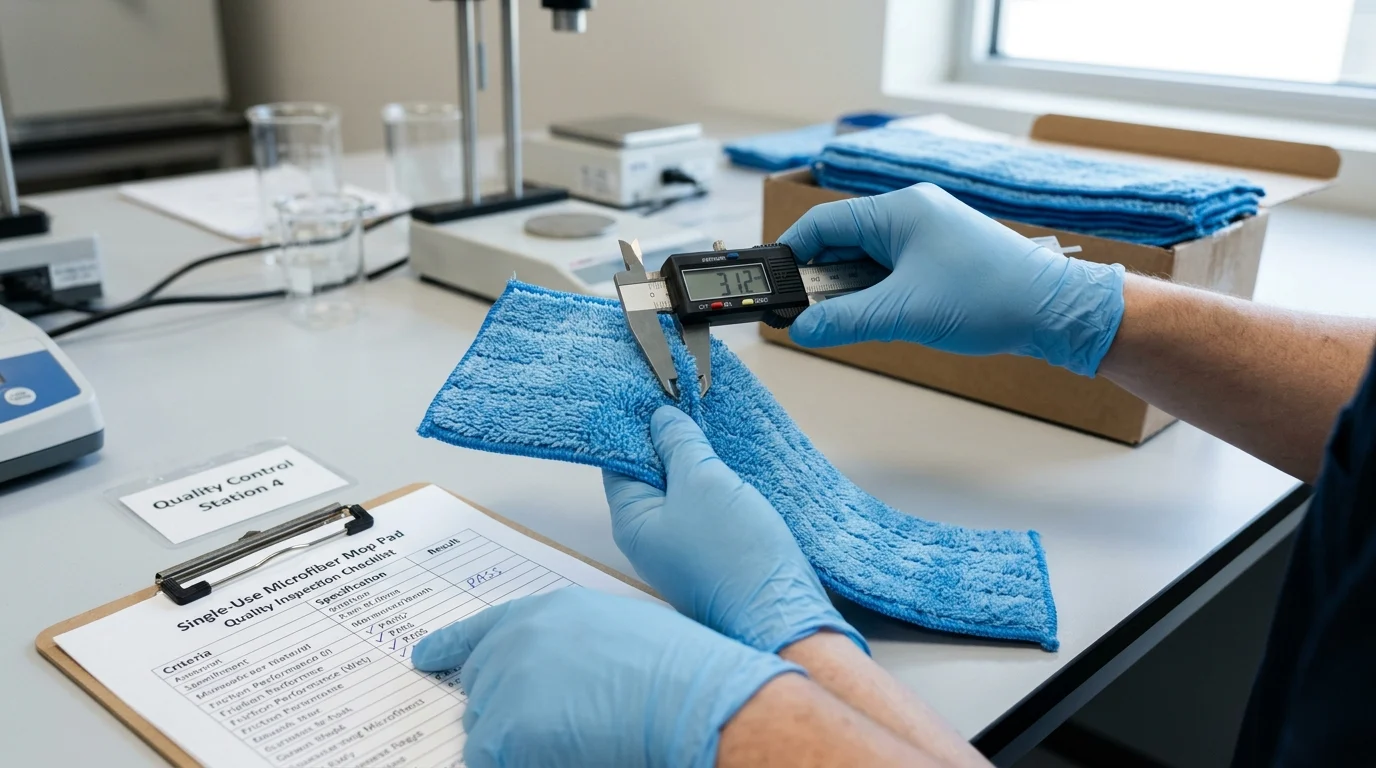
Transitioning a facility to a single-use floor care system extends beyond product selection; it demands comprehensive supply chain management, compliance verification, and environmental impact analysis.
Successful implementation relies on establishing robust logistics networks and conducting thorough pilot testing to validate both the clinical efficacy and the operational feasibility of the new protocols.
Which sourcing, compliance, packaging, and logistics factors matter
Reliable procurement of a single use microfiber mop pad requires vetting suppliers based on their manufacturing capabilities and quality management systems. Facilities must establish clear Minimum Order Quantities (MOQs), which frequently range from 5,000 to 10,000 units per pallet, to ensure supply chain continuity and secure favorable freight pricing.
For specialized environments like pharmaceutical compounding pharmacies or semiconductor manufacturing, compliance factors are critical. Pads destined for these areas must be processed and packaged in cleanrooms to meet ISO Class 5 to 7 particulate standards. Vacuum-sealed, double-bagged packaging is mandatory in these sectors to prevent external contamination during transit and to facilitate sterile transfer into the controlled environment.
What decision steps support procurement and environmental review
Facility managers must balance strict infection control mandates with broader corporate sustainability
Key Takeaways
- The most important conclusions and rationale for microfiber disposable mop pad
- Specs, compliance, and risk checks worth validating before you commit
- Practical next steps and caveats readers can apply immediately
Frequently Asked Questions
What makes a microfiber disposable mop pad effective for cross-contamination prevention?
Its split microfiber traps soil and microbes, and the pad is discarded after one room or zone, reducing transfer to adjacent areas.
Where are disposable microfiber mop pads most useful?
They are ideal for high-risk spaces like patient rooms, isolation wards, ICUs, cleanrooms, and pharmaceutical compounding areas.
How much area can one 18-inch disposable microfiber mop pad clean?
A standard 18-inch pad typically covers about 200 to 250 square feet of smooth flooring before it should be replaced.
Which specifications should buyers check before choosing a pad?
Focus on an 80/20 polyester-polyamide blend, 40 to 60 GSM, 5 to 8 times absorbency, and strong hook-and-loop backing.
Why can disposable microfiber mop pads work better with disinfectants than reusable pads?
Engineered single-use pads are often non-binding, so quaternary ammonium disinfectants stay at full intended concentration on the floor.