

 Send Email
 whatsapp


The Big Why How Disposable Hospital Curtains Revolutionize Healthcare

Disposable hospital curtains fundamentally transform healthcare environments. They offer a critical innovation against healthcare-associated infections (HAIs). HAIs affect one in 31 U.S. hospitalized patients, costing billions annually. This shift, championed byhospital curtain manufacturers, significantly enhances patient safety and operational efficiency. Many medical room curtains, including medical privacy curtain designs, now feature disposable curtains.
Key Takeaways
- Disposable hospital curtains stop the spread of germs. They have special materials that kill bacteria, making hospitals safer for everyone.
- These curtains are easy to change. This saves time and money because hospitals do not need to wash them. This helps hospitals run better.
- Using Disposable curtains makes patients and staff feel safer. They know the hospital is clean and working hard to prevent sickness.
The Urgent Need for Change: Why Traditional Hospital Curtains Fall Short
Traditional healthcare environments often rely on practices that, while once standard, now present significant challenges to modern infection control. Traditional hospital curtains, in particular, pose a substantial risk. They frequently become breeding grounds for harmful pathogens, complicate cleaning efforts, and create hidden operational burdens for healthcare facilities. Recognizing these shortcomings is crucial for understanding the transformative power of disposable alternatives.
Traditional Hospital Curtains as Unseen Pathogen Reservoirs
Traditional hospital curtains, designed for patient privacy, inadvertently become significant reservoirs for dangerous microorganisms. These fabric barriers, often touched by many individuals, quickly accumulate a variety of healthcare-associated pathogens. Studies consistently show rapid contamination. For instance, researchers found that 92% of traditional hospital privacy curtains showed contamination with pathogenic bacteria like MRSA and VRE within just one week of use.
The types of pathogens found on these surfaces are concerning. Common culprits include Methicillin-resistant Staphylococcus aureus (MRSA) and Vancomycin-resistant enterococcus (VRE). Other detected bacteria include Staphylococcus aureus, Enterococcus spp, and aerobic gram-negative rods. These pathogens can survive on fabric surfaces for extended periods. One study revealed that 87% of traditional hospital curtains became contaminated with MRSA after only 14 days of use. Another comprehensive study, analyzing 1,521 samples from privacy curtains, found that 22% tested positive for multidrug-resistant organisms (MDROs). Within these MDROs, vancomycin-resistant enterococci (VRE) appeared in 13.8% of cultures, drug-resistant gram-negative bacteria in 6.2%, and methicillin-resistant Staphylococcus aureus (MRSA) in 4.9%. This persistent presence of harmful bacteria highlights the critical role traditional curtains play in pathogen transmission.
Ineffective Cleaning Protocols for Hospital Curtains
The cleaning protocols for traditional hospital curtains often fall short of what is necessary to prevent pathogen spread. There is no universal standard for how often facilities should clean these curtains. Different healthcare facilities adopt varied approaches based on their specific needs, location, contact frequency, and contamination risk. Guidelines suggest immediate changes for visibly soiled curtains and for those in isolation cases once patients leave. For ongoing cases, quarterly changes or recommendations from infection control teams are common. However, these guidelines are not always consistently applied or sufficient.
Several challenges hinder effective cleaning. Curtain fabrics are complex; they easily trap contaminants like dust, dirt, and bacteria, which general cleaning methods cannot effectively remove. Healthcare facilities clean traditional hospital curtains less frequently than hard surfaces, making them more susceptible to contamination. High contact frequency by staff, patients, and visitors leads to rapid re-contamination, as people often touch curtains without gloves. Furthermore, in-house cleaning efforts typically focus on high-touch hard surfaces, often overlooking the specialized cleaning required for curtains. This oversight allows bacteria, such as MRSA, to survive on fabric surfaces for long periods, leading to curtains becoming re-contaminated quickly even after cleaning.
The Hidden Operational Burden of Reusable Hospital Curtains
Beyond infection risks, reusable hospital curtains impose a significant operational burden on healthcare facilities. Their maintenance involves a complex and resource-intensive process. The general lifespan of a good quality woven textile is approximately ten years, but this longevity comes with ongoing cleaning demands. For example, in Britain, reusable curtains require cleaning at 60 degrees at least every six months, and immediately if soiled. Australian guidelines vary by risk area, ranging from immediate changes in very high-risk zones to annual cleaning in low-risk areas.
The laundering process itself consumes vast amounts of resources. Laundering reusable hospital textiles requires large quantities of water, producing an equivalent amount of wastewater. Even with wastewater treatment and recycling, the laundry operation demands significant energy consumption. While reusable textiles offer a longer lifespan and some environmental advantages over disposables in terms of waste volume, the laundering process is resource-intensive. It consumes more energy and water and adds more wastewater to the environment compared to disposable alternatives. This continuous cycle of removal, laundering, and re-installation adds to labor costs, logistical complexities, and environmental impact, creating a hidden burden that many facilities overlook.
The Revolutionary Impact of Disposable Hospital Curtains
Disposable hospital curtains represent a significant leap forward in healthcare hygiene and operational efficiency. They directly address the shortcomings of traditional curtains by offering advanced features and streamlined processes. This innovation fundamentally changes how facilities manage infection risks and maintain a clean environment.
Advanced Antimicrobial Properties in Disposable Hospital Curtains
A key advantage of disposable hospital curtains lies in their advanced antimicrobial properties. Manufacturers design these curtains with materials that actively inhibit the growth and spread of bacteria, fungi, and other microorganisms. This proactive approach significantly reduces the pathogen load within patient environments.
An experimental study demonstrated a significant reduction in bacterial colony-forming units (CFU/cm²) on antibacterial Fantex protective privacy curtains. After 24 hours of contamination with various bacteria, including Pseudomonas aeruginosa, Acinetobacter baumannii, MRSA, and extended-spectrum-producing organisms (Escherichia coli or Klebsiella pneumoniae), these curtains showed a marked decrease compared to standard privacy curtains. Furthermore, environmental contamination levels with several bacterial species were significantly lower on Fantex curtains after two months of use in an emergency department.
The data clearly illustrates this effectiveness:
| Curtain Type | Bacterial CFUs |
|---|---|
| Traditional Curtains | 32.6 |
| Antimicrobial Curtains | 0.56 |
| Reduction | 98.3% (P < 0.05) |
This substantial reduction in bacterial presence directly translates to a safer environment for patients and staff.
Seamless Integration and Rapid Replacement of Disposable Hospital Curtains
Disposable hospital curtains offer unparalleled ease of integration and replacement, dramatically improving operational workflows. Healthcare facilities can exchange these curtains in under one minute when staff use tools like the Grabber tool. This speed significantly enhances patient room turnover rates.
The logistical advantages of these rapid replacement systems are numerous:
- Faster Installation: Staff can swap out disposable curtains in minutes using quick-change track systems, saving valuable time.
- Reduced Labor: They eliminate the extensive handling, laundering, and reinstallation required for traditional fabric curtains.
- Streamlined Operations: Staff can quickly replace curtains without disrupting daily operations, avoiding delays in patient care caused by strict cleaning schedules.
- Elimination of Complex Cleaning: Unlike fabric curtains that require frequent washing at high temperatures and quick turnaround times, disposable curtains are simply replaced, removing the logistical challenges of laundry.
These systems also offer additional benefits:
- Lightweight and Easy to Install: This characteristic facilitates quick replacements.
- Cost-Effective: They reduce laundry and labor costs associated with traditional curtains.
- Eliminates Cleaning Schedules: They remove the need for strict, time-consuming, and costly cleaning schedules for traditional curtains.
Enhancing Infection Control with Single-Use Hospital Curtains
Single-use hospital curtains are a cornerstone of modern infection control strategies. They provide a proactive measure against healthcare-associated infections (HAIs) by ensuring a consistently clean environment.
Disposable hospital curtains contribute to HAI reduction in several ways:
- They eliminate cross-contamination risks.
- They reduce the burden of constant laundering.
- They enhance hospital efficiency.
- They are a proactive infection control measure.
Healthcare facilities must establish clear guidelines for replacing these curtains to maximize their effectiveness. It is highly recommended that disposable hospital curtains be changed every six months, with the installation date clearly marked on the curtain.
Specific clinical settings often require more frequent changes:
- CDC Minimum Standard: At least once every month.
- Immediate Replacement: Required for visible soiling, contamination, damage, or contact with blood/body fluids.
- High-Risk Zones (ICUs, Isolation Rooms): These areas may require more frequent changes, sometimes weekly, due to heightened vulnerability and contamination likelihood.
- Customized Schedules: Hospitals often develop tailored schedules based on departmental risks and patient demographics.
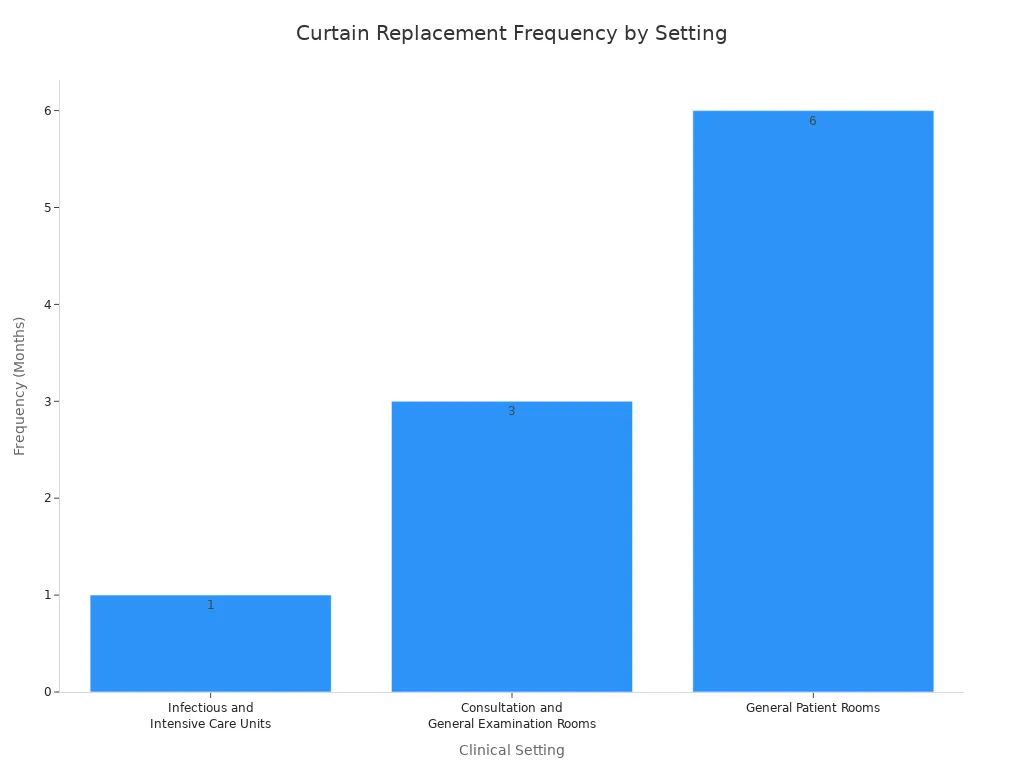
Here is a general guide for replacement frequency:
| Clinical Setting | Recommended Replacement Frequency |
|---|---|
| Infectious and Intensive Care Units | Monthly |
| General Patient Rooms | Every 6 months |
| Consultation and General Examination Rooms | Every 3 months |
Tangible Benefits: How Disposable Hospital Curtains Elevate Healthcare
Disposable hospital curtains offer significant advantages. They improve patient safety, streamline operations, and enhance overall confidence in healthcare environments. These benefits make them an essential component of modern infection control strategies.
Eliminating Cross-Contamination Risks with Disposable Hospital Curtains
Disposable hospital curtains significantly reduce the risk of cross-contamination. Studies indicate that using disposable patient drapes can lead to a reduction in infection rates by up to 30%. This directly enhances hospital safety and infection control. Many contemporary disposable curtains feature antimicrobial properties. These agents hinder the proliferation of bacteria, fungi, and other microorganisms. This provides an additional layer of defense against pathogens. Research frequently shows that privacy curtains in patient rooms can harbor bacteria, including drug-resistant strains. Experts suggest that redesigning these curtains or using disposable alternatives helps prevent microbial spread.
Streamlining Facility Management and Reducing Labor Costs
Disposable hospital curtains streamline facility management and reduce labor costs. They eliminate the need for extensive laundering processes. This saves significant resources in water, energy, and labor. While initial outlay for disposable curtains is similar to washable ones, they prove cost-effective in the long run. They remove the labor-intensive cleaning and sterilization required for reusable drapes. Disposable curtains also simplify inventory. They often come in a single panel size (66”x 105”). Rod-set adaptors accommodate varying ceiling heights, allowing uniform use across departments. Labels on each hospital curtain facilitate tracking installation dates. This improves inventory management and ensures compliance with cleaning policies.
Boosting Patient and Staff Confidence in Hospital Hygiene
Disposable hospital curtains contribute to a safer working environment for healthcare staff. They significantly lower the risk of spreading infections between patients and staff. Traditional fabric curtains can harbor pathogens even after washing. Disposable curtains, designed for single use, prevent this. Their antimicrobial properties actively inhibit microbial growth. This creates a cleaner environment for healthcare workers. The disposable nature removes the necessity for staff to handle potentially contaminated laundry. This saves time and resources while reducing exposure risks. Using disposable curtains helps facilities adhere to strict infection control guidelines. This demonstrates a commitment to safety for both patients and staff.
Disposable hospital curtains are indispensable for modern healthcare hygiene. They represent a strategic investment in patient safety and operational excellence. Facilities embracing this innovation secure a healthier, safer healthcare future. This advanced hospital curtain technology revolutionizes patient care and operational efficiency.
FAQ
How do disposable hospital curtains prevent infections?
Disposable curtains feature antimicrobial properties. These properties actively inhibit pathogen growth. Regular replacement eliminates contaminated surfaces, significantly reducing cross-contamination risks.
Are disposable hospital curtains more cost-effective than reusable ones?
Yes, they are. Disposable curtains eliminate laundering costs, labor for cleaning, and reinstallation. This streamlines facility management and reduces overall operational expenses.
What is the environmental impact of using disposable curtains?
Manufacturers often design disposable curtains from recyclable materials. Their use reduces water and energy consumption associated with laundering reusable curtains. This minimizes environmental impact.
