

 Send Email
 whatsapp


Unpacking the Power Why Cleaning Experts Trust Microfiber Mops

Cleaning professionals overwhelmingly prefer the Microfiber Mop. They recognize its superior performance. Thisfloor cleaning mop is the go-to tool for exceptional cleanliness. Experts trust the microfiber floor mop due to its unmatched capabilities. The microfiber flat mop offers excellent results. A washable microfiber mop provides great value among cleaning mops for floors.
Key Takeaways
- Microfiber mops clean floors better than regular mops. They pick up almost all dirt and germs, leaving surfaces very clean.
- Microfiber mops help you clean faster and use less water and chemicals. This saves time and is better for the environment.
- Microfiber mops are safer because floors dry quickly, stopping slips. They also last a long time and help keep germs from spreading.
Superior Cleaning Performance of Microfiber Mops

Cleaning professionals consistently choose microfiber mops for their exceptional ability to deliver a higher standard of cleanliness. These tools excel in several key areas, making them indispensable for effective floor care.
Unrivaled Dirt and Germ Trapping by Microfiber Mops
Microfiber mops demonstrate a remarkable capacity for capturing dirt and germs. Their design features dense, small fibers that effectively reach into the cracks and uneven surfaces of floors. This unique structure allows them to trap an impressive 99.5% of dirt and germs. In contrast, traditional cotton mops often push dirt around, lifting only a fraction of it. The fixed Flat Mop head of a microfiber mop also enables significant downward pressure, which helps remove stubborn stains without damaging the floor surface.
The synthetic materials, such as polyester and polyamide, form ultra-fine fibers. These fibers create a static charge that actively lifts dirt, dust, bacteria, and other debris from surfaces. Studies show that microfiber systems achieve a 95% microbial removal rate when used with a detergent cleaner. Traditional cotton string mops, under the same conditions, only achieve a 68% microbial removal. This highlights the superior performance of microfiber mops in reducing bacteria counts. Microfiber is particularly effective at catching and retaining dust, including fine particles, due to its unique structure. Its ultra-fine synthetic fibers are often smaller than a human hair, allowing them to access microscopic crevices and effectively capture dust, dirt, and bacteria.
Lint-Free and Streak-Free Finish with Microfiber Mops
Achieving a pristine, streak-free finish is a hallmark of professional cleaning, and microfiber mops excel in this regard. Microfiber cloths are well-known for their 'lint-free properties,' which ensure surfaces remain free of residue. Their fine, non-abrasive fibers delicately remove fingerprints and smudges without scratching sensitive surfaces or leaving any unwanted marks. This characteristic makes them ideal for cleaning delicate areas prone to streaks and lint when cleaned with other materials like paper towels or cotton cloths.
The scientific explanation for this superior finish lies in the microfiber's design. Microfiber systems lift and trap dirt at a microscopic level, unlike traditional cotton mops that tend to push soil around. The fibers create a static charge that, combined with their unique structure, captures dirt instead of merely spreading it. Microfiber consists of ultra-fine polyester fibers, approximately 1/100th the thickness of a human hair. This allows them to pick up microscopic dirt, dust mites, and other fine particles that traditional cloths miss. Furthermore, microfiber cloths possess an ionic charge, combining positive-charged polyester and negative-charged nylon fibers. This acts like a magnet, attracting particles of dust, dirt, and grease. When used with a two-bucket system that separates clean solution from rinse water, microfiber significantly reduces residue and streaking.
Enhanced Absorption Capabilities of Microfiber Mops
Beyond their trapping and streak-free qualities, microfiber mops offer enhanced absorption capabilities. Microfiber cloths are manufactured with specially segmented fibers, which are split up to 16 times. This high level of splitting significantly increases the cloth's surface area, enhancing its capacity to absorb moisture and dirt. The fine pores of microfiber make it highly absorbent, efficiently pulling in moisture like a sponge. This superior absorption means surfaces dry faster, reducing the risk of slips and falls and allowing for quicker room turnover.
Efficiency and Productivity Gains with Microfiber Mops
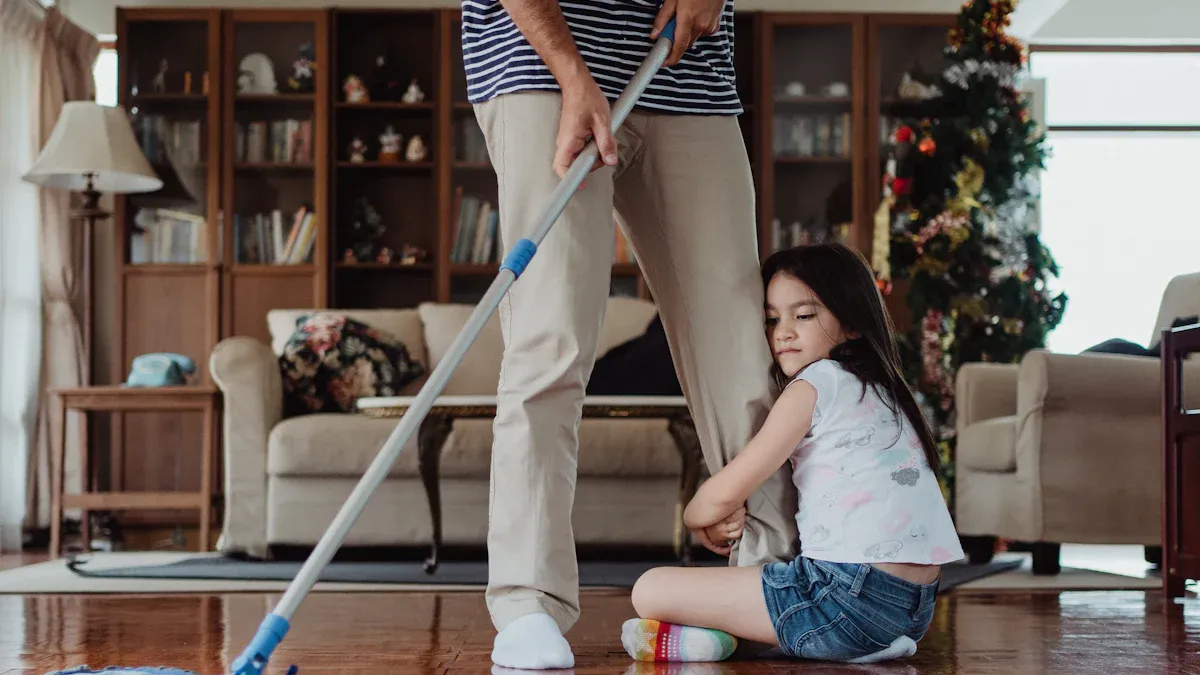
Cleaning professionals consistently choose microfiber mops because they significantly boost efficiency and productivity. These tools allow teams to complete tasks faster and with less effort, leading to better overall operational outcomes.
Reduced Water and Chemical Usage by Microfiber Mops
Microfiber mops offer substantial reductions in both water and chemical consumption. This not only benefits the environment but also lowers operational costs for cleaning businesses. Traditional cleaning methods often require large volumes of water and cleaning solutions. However, microfiber technology changes this dynamic.
| Mop Type | Water Usage (Gallons per 100 rooms) |
|---|---|
| Conventional Wet Loop Mops | 105 |
| Microfiber Mop | 5 |
A dual-chamber system, when paired with a microfiber flat mop, can reduce water and chemical consumption by up to 66 percent. This efficiency is a major advantage. Microfiber mops generally necessitate the use of fewer chemicals overall compared to conventional cleaning alternatives. This contributes to a more sustainable business model. Microfiber mop systems can achieve approximately a 90% reduction in cleaning and disinfection chemicals compared to traditional string mops. For instance, a string mop process might use 21 gallons of floor cleaning solution per worker per shift. A microfiber system, however, would only require two gallons. This drastic reduction highlights the economic and environmental benefits.
Faster Drying Times with Microfiber Mops
Faster drying times are another significant advantage of microfiber mops. They leave less residual moisture on floors. This means surfaces dry more quickly, which is crucial for safety and operational flow.
| Mop Type | Drying Time |
|---|---|
| Cotton String Mop | 15 minutes |
| Microfibre Flat Mop | 7 minutes |
- Microfiber mops dry quickly.
Reduced drying times minimize the risk of slips and falls, a common hazard on wet floors. It also allows for quicker room turnover in commercial settings, improving overall productivity. Cleaning teams can complete their work and allow areas to be used again sooner.
Lightweight and Ergonomic Design of Microfiber Mops
Microfiber mops are designed with the user's ergonomics in mind. They significantly reduce the heavy lifting and awkward twisting motions associated with wringing and using traditional wet string mops. This is largely due to eliminating the need for repeatedly filling, lifting, moving, and dumping heavy mop buckets. The use of these ergonomic tools dramatically lowers the risk of repetitive stress injuries, such as back strain, which are a major cause of workers' compensation claims. Simultaneously, the lightweight design of microfiber mops contributes to maximizing custodial productivity by making tasks less physically demanding.
- Reduced Effort: Microfiber mops are lightweight and easy to use. They allow cleaning teams to complete tasks with less physical exertion.
- Fewer Trips to Mop Bucket: Microfiber is more absorbent than traditional mops. This means fewer trips are needed to wring out the mop, reducing repetitive movements and strain.
- Enhanced Safety: Microfiber mops leave less residual moisture on floors. This speeds up drying times and reduces the risk of slips and falls compared to traditional mops that leave wet streaks and spots.
Cleaning professionals report significant ergonomic benefits from lightweight microfiber mops. Glenn Rothstein, president of Bio-Shine, notes that microfiber mops are lighter and absorb less liquid than traditional mops. Traditional mops become heavy and difficult to maneuver when wet. This lightness directly reduces physical strain. Furthermore, the use of microfiber systems with interchangeable handles and pads helps reduce fatigue and the risk of hyperextension injuries. For instance, one manager switched his crew to a backpack and flat mop system for floor finishing due to an increase in injuries. He reported no injuries since the change. Adjustable/telescopic wands and poles also improve posture, eliminate the need for ladders, and extend reach safely. Janitors at The University of Maryland use aluminum telescopic poles to clean high windows without injury risk. Adjusting mop handle length to the custodian's forehead height further reduces bending and improves safety. These ergonomic advantages translate into significant labor efficiency gains.
| Mop Type | Labor Efficiency (sq ft/hour) |
|---|---|
| Cotton Damp Mops | 5,000 |
| Microfiber Damp Mops | 23,000 |
This table clearly shows the increased productivity achieved with microfiber damp mops.
Safety, Sustainability, and Versatility of Microfiber Mops
Cleaning professionals value microfiber mops for their contributions to safety, environmental responsibility, and adaptability across various cleaning tasks. These tools offer significant advantages beyond just superior cleaning power.
Minimized Slip and Fall Hazards with Microfiber Mops
Microfiber mops play a crucial role in enhancing safety by significantly reducing slip and fall hazards. They achieve this by leaving less residual moisture on floors. Traditional mops often leave streaks and wet spots, which extend drying times and increase the risk of accidents. Microfiber mops, however, offer superior absorbency. They soak up more water than traditional cotton, wool, or viscose mops. This higher absorbency results in faster floor drying times. Faster drying significantly reduces the risk of slips and falls, which is particularly crucial in high-traffic environments like hospitals. Microfiber mops also reduce cleaning time. They can absorb up to seven times their weight in liquid, leading to quicker drying times. This rapid drying effectively decreases slip hazards and minimizes downtime, making spaces safer for everyone sooner.
Reduced Cross-Contamination Risks Using Microfiber Mops
Microfiber mops are highly effective at preventing the spread of pathogens across different surfaces. Disposable microfiber mop pads excel at minimizing cross-contamination. Traditional mopping systems, by reusing mop heads, can inadvertently transfer microbes between areas, increasing infection spread. Disposable pads, however, are used once and discarded. This prevents contaminant movement, which is vital in high-risk environments like hospitals. This single-use approach ensures a fresh, uncontaminated tool for each cleaning session. It supports stringent hygiene and reduces healthcare-associated infections (HAIs).
Disposable microfiber mop pads are highly effective at removing microbes and contaminants from hospital floors and surfaces. Their unique composition allows them to attract and hold dirt, bacteria, and viruses more efficiently than traditional cotton or sponge mops. This ability to capture and remove microscopic particles is crucial in preventing the spread of pathogens that cause infections. Unlike traditional mopping systems that can spread microbes, disposable pads are used once and discarded. This significantly reduces the risk of transferring infectious agents, especially in critical areas like isolation rooms and ICUs.
Microfiber, made of fine polyester and polyamide strands, creates a vast surface area with millions of spaces. These spaces trap moisture, dirt, and debris. Its curled ends reach into tiny cracks, attaching to and trapping microscopic dirt and germs. Larger cotton fibers merely push these particles around. Additionally, the static charge generated by millions of microfibers brushing against each other attracts dirt and germs, enhancing cleaning effectiveness. This trapped material is only released when the mop is laundered.
Cleaning professionals often implement color-coding protocols to further minimize cross-contamination risks. This system simplifies complex tasks by providing mental shortcuts. It reinforces established protocols, leading to standardized and reliable cleaning routines. Color-coding acts as a mnemonic device, aiding in remembering and executing procedures. It contributes to standardization and compliance, minimizing errors and ensuring uniform procedures. This practice lessens the overall cost of sanitation programs by mitigating risks of cross-contamination and incorrect product use. It also protects brand image and public trust.
| Color | Risk Area/Task |
|---|---|
| Red | High-contamination risk areas |
| Blue | General areas for all-purpose cleaning |
| Yellow | Less risky, low-traffic floor areas |
| Green | Food preparation areas and break rooms |
Another common color-coding system categorizes risk levels:
| Color | Risk Area/Task |
|---|---|
| Blue | General cleaning in low-risk areas |
| Yellow | Medium-risk areas (restroom sinks, mirrors, healthcare, labs) |
| Green | High-risk areas (break rooms, cafeterias, kitchens) |
| Red | Very high-risk areas (toilets, urinals) |
Eco-Friendly and Durable Design of Microfiber Mops
Microfiber mops offer significant environmental benefits and boast impressive durability. Their design supports sustainable cleaning practices. High-quality microfiber cloths from leading brands can last up to 300 washes. A specific product, 'i-fibre', even offers a guarantee of 750 washes. Low-quality microfiber cleaning cloths may have an effective life of as few as 50 washes. Microfiber mop heads are known for their durability. They can withstand between 150 and 200 washes without showing signs of degradation. This extended lifespan reduces waste compared to disposable alternatives.
Many eco-friendly microfiber mop products receive environmental certifications. The Nordic Swan Ecolabel is a prominent certification for eco-friendly mops and cloths, including microfiber products. It aims to reduce environmental impact from production and consumption. This helps consumers choose environmentally superior goods. Microfiber products awarded this label are considered best-in-class for their environmental profile. The certification process evaluates the entire life cycle, from material selection and production to packaging, product quality, and performance. Functionality tests cover dirt and dust removal, microorganism removal, absorption capacity, non-scratching properties, and dimensional changes during washing and drying. Other notable certifications include:
- LEED Certification
- U.S. EPA Environmentally Preferable Purchasing
- U.S. EPA Comprehensive Procurement Guidelines
- U.S. EPA Design for the Environment
- Green Seal
- EcoLogo
- EPA Certified
These certifications underscore the commitment of manufacturers to produce environmentally responsible cleaning tools.
Microfiber mops are indispensable tools for cleaning professionals. Their benefits extend beyond superior cleanliness. They also offer significant gains in efficiency, safety, and sustainability. Investing in this advanced microfiber mop technology is a smart choice. It consistently delivers superior cleaning outcomes.
FAQ
How often should one wash microfiber mop pads?
Cleaning professionals wash microfiber mop pads after each use. This maintains hygiene and performance. Regular washing extends the mop's lifespan.
Can microfiber mops be used dry?
Yes, microfiber mops work effectively dry. They attract dust and debris through static electricity. This makes them excellent for dusting floors.
Are microfiber mops safe for all floor types?
Microfiber mops are safe for most floor types. They clean hardwood, tile, and laminate without scratching. Always check manufacturer guidelines for delicate surfaces.
Tip: Always follow the specific care instructions provided by the mop manufacturer to ensure optimal performance and longevity.
