

 Send Email
 whatsapp


Introduction
Microfiber Cleaning cloths have become the preferred choice for buyers who need better cleaning performance, lower waste, and more consistent supply than cotton can usually provide. Made from ultra-fine synthetic fibers, they trap dust, grease, and moisture more efficiently while reducing lint and chemical use across commercial cleaning, healthcare, and detailing applications. For procurement teams, the difference is not only technical but operational: cloth durability, absorption, and manufacturing consistency all affect cost at scale. This article explains what microfiber actually is, why it outperforms cotton in demanding environments, and how choosing the right bulk microfiber cleaning cloth supplier supports quality control, pricing, and long-term purchasing reliability.
Why a Bulk Microfiber Cleaning Cloth Supplier Matters
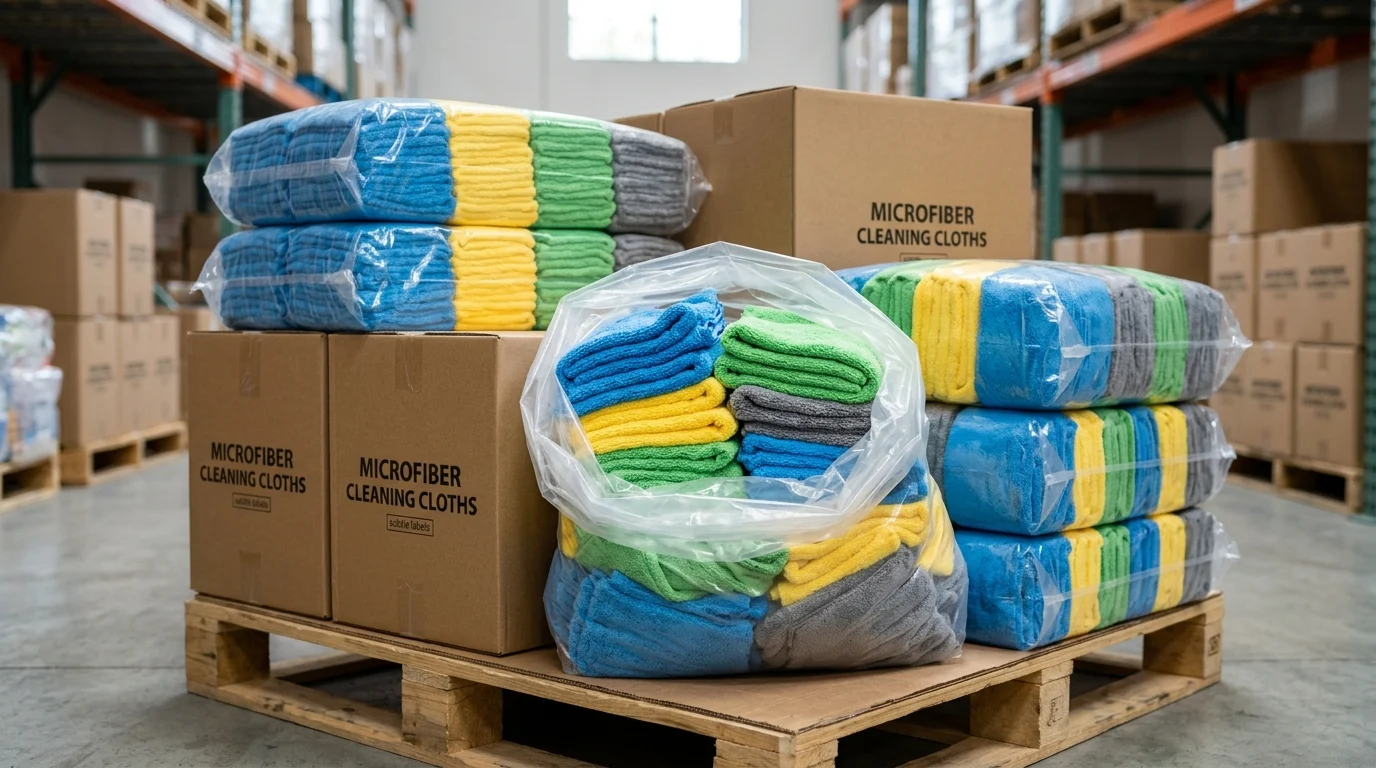
The commercial cleaning, healthcare sanitation, and automotive detailing sectors have undergone a fundamental shift in material procurement, moving decisively away from traditional natural fibers. Central to this transition is the strategic partnership with a reliable bulk microfiber cleaning cloth supplier. Procuring high-performance synthetic textiles at scale ensures operational consistency, standardizes sanitation protocols, and optimizes unit economics. For institutional buyers, leveraging economies of scale—often through minimum order quantities (MOQs) exceeding 10,000 units—can yield unit cost reductions of 25% to 30%, making upstream supply chain reliability a paramount concern for procurement officers.
What Defines a Microfiber Cleaning Cloth
At the microscopic level, a microfiber cleaning cloth is a synthetic textile engineered primarily from a precise blend of polyester and polyamide (nylon). To qualify strictly as microfiber under textile manufacturing standards, the individual strands must measure less than 1.0 denier in diameter. High-grade commercial variants typically range between 0.1 and 0.2 denier, rendering them approximately 100 times finer than a human hair. The standard industry blend utilizes 80% polyester to provide structural integrity and an electrostatic charge, paired with 20% polyamide for superior liquid absorption. Premium iterations frequently utilize a 70/30 ratio to maximize capillary action and tactile softness.
Why Buyers Are Replacing Cotton
Facilities managers are systematically phasing out cotton due to its inherent structural limitations. Cotton fibers are relatively massive and smooth, meaning they tend to push dirt, bacteria, and debris across surfaces rather than capturing them. Consequently, cleaning with cotton demands higher volumes of aqueous solvents and chemical agents to achieve acceptable sanitation levels. Conversely, the split structure of a Microfiber Cloth generates a net positive electrostatic charge that aggressively attracts negatively charged dust particles and microbes. Empirical field data indicates that implementing microfiber protocols can reduce surface chemical usage by up to 90% and lower water consumption by 95%, driving substantial improvements in both environmental compliance and facility operating margins.
Why Microfiber Outperforms Cotton
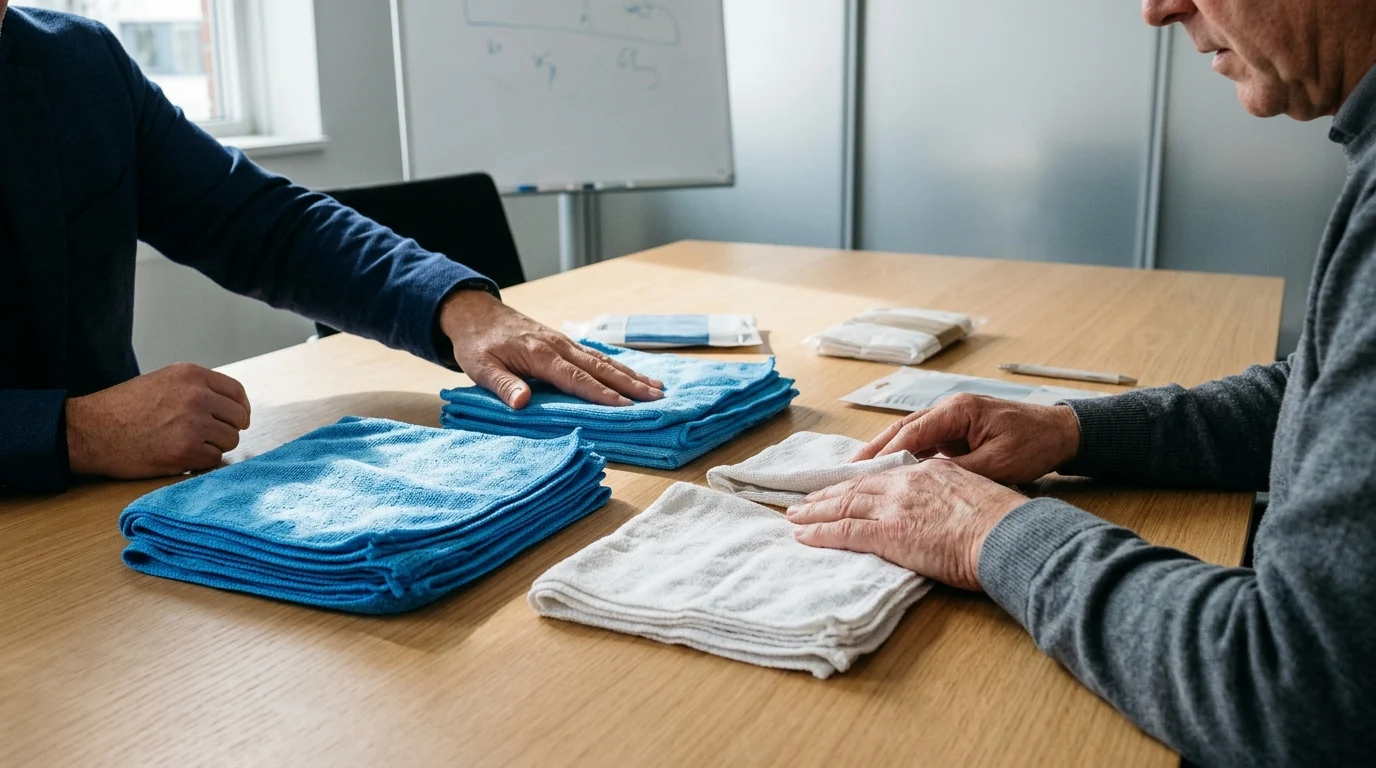
The performance delta between microfiber and traditional cotton is rooted in physics and material science, specifically capillary action and Van der Waals forces. When the synthetic fibers are split during the manufacturing process, they create millions of microscopic crevices. These voids drastically increase the total surface area of the textile, allowing it to trap particulate matter at a microscopic scale without relying on chemical surfactants. Quantitatively, a high-quality microfiber textile can absorb and retain up to seven to eight times its dry weight in liquid, whereas standard commercial cotton reaches saturation at merely three to four times its weight.
Key Specifications to Compare
When sourcing a wholesale microfiber cleaning cloth, buyers must evaluate textiles based on Grams per Square Meter (GSM), blend ratio, and weave type. GSM dictates the density and pile of the fabric. Standard multi-purpose commercial cleaning cloths typically range from 250 to 300 GSM, offering an optimal balance of agility and absorbency. Heavy-duty automotive detailing or spill-recovery cloths require a higher density, often spanning 400 to 600 GSM. Furthermore, durability metrics heavily favor synthetics; a commercial-grade microfiber cloth is engineered to withstand 500 to 600 rigorous commercial wash cycles at 60°C (140°F), whereas cotton terry cloths typically degrade, fray, or lose structural integrity after 100 to 200 cycles.
Microfiber vs Cotton at a Glance
To quantify the operational advantages, the following table outlines the stark contrasts in performance metrics between standard split-microfiber and traditional commercial cotton textiles.
| Performance Metric | Premium Microfiber (80/20 Blend) | Traditional Commercial Cotton |
|---|---|---|
| Fiber Diameter | 0.1 – 0.2 denier | 15 – 20 denier |
| Liquid Absorption | 7x – 8x dry weight | 3x – 4x dry weight |
| Lifecycle Durability | 500+ commercial wash cycles | 100 – 200 commercial wash cycles |
| Chemical Reduction | Up to 90% reduction | Baseline dependence |
| Bacterial Removal | 99% (mechanical removal) | 30% – 33% (mechanical removal) |
How to Evaluate a Bulk Microfiber Cleaning Cloth Supplier

Transitioning from localized purchasing to importing directly from an OEM microfiber cleaning cloth manufacturer requires rigorous vetting of production capabilities and quality control frameworks. A highly capable supplier does not merely offer competitive pricing; they provide verifiable consistency in fiber splitting, edge finishing, and dye colorfastness. Institutional buyers must establish strict acceptable quality limits (AQL), typically capping critical defect rates below 1.5% per production run. Additionally, evaluating logistical parameters such as standard lead times—which generally range from 25 to 35 days for bulk sea freight—is critical to preventing stockouts in high-volume janitorial operations.
Practical Steps to Qualify Suppliers
The qualification process should initiate with laboratory or empirical testing of physical samples. Procurement teams must verify the GSM tolerance (acceptable variance is typically ±5%) and confirm the blend ratio using chemical dissolution tests if necessary. It is also vital to inspect the edge finishing; ultrasonic cut edges prevent scratching in sensitive applications like optics or automotive clear coats, whereas overlock stitching provides maximum durability for heavy janitorial use. Furthermore, assessing a vendor's capacity to produce a custom microfiber cleaning cloth—including specific Pantone matching for color-coded cross-contamination prevention programs—is a strong indicator of advanced manufacturing maturity.
Decision Checklist for Buyers
To systematically mitigate supply chain risk, procurement officers should utilize a structured evaluation matrix before issuing a purchase order. Key decision criteria include:
- Manufacturing Certifications: Ensure the facility holds ISO 9001 for quality management and potentially ISO 14001 for environmental compliance.
- MOQ Thresholds: Confirm that the minimum order quantities align with inventory turnover rates (e.g., standard MOQs of 3,000 to 5,000 pieces per specific color/size).
- Material Innovation: Check for the availability of an eco friendly microfiber cleaning cloth line, such as those manufactured from rPET (recycled polyethylene terephthalate) to meet corporate sustainability mandates.
- Dye Sublimation and Labeling: Verify the ability to execute high-temperature dye sublimation for private labeling without compromising the capillary action of the fibers.
Key Takeaways
- The most important conclusions and rationale for bulk microfiber cleaning cloth supplier
- Specs, compliance, and risk checks worth validating before you commit
- Practical next steps and caveats readers can apply immediately
Frequently Asked Questions
What is a microfiber cleaning cloth?
It is a synthetic cloth made mainly from polyester and polyamide fibers that are much finer than cotton, helping capture dust, liquid, and debris more effectively.
Why is microfiber better than cotton for commercial cleaning?
Microfiber traps particles instead of pushing them around, absorbs more liquid, and can reduce chemical and water use, making it more efficient for routine cleaning.
What blend ratio should bulk buyers choose?
Use 80/20 for general-purpose cleaning and 70/30 for higher absorbency and softness, especially in healthcare, janitorial, or detailing applications.
What GSM is best for a wholesale microfiber cleaning cloth?
Choose 250–300 GSM for daily multi-purpose cleaning, and 400–600 GSM for automotive detailing, spill control, or heavier-duty tasks.
How do I evaluate a bulk microfiber cleaning cloth supplier?
Check blend consistency, GSM accuracy, wash-cycle durability, MOQ, lead time, and whether the supplier can support stable large-volume orders with consistent quality.