

 Send Email
 whatsapp


Is Your Microfiber Towel Drying You Faster in 2025

Yes, your Microfiber Towel remains the ultimate solution for quick drying in 2025. Its superior efficiency continues to outperform other options. Tests show a microfiber towel reduces drying time by up to 50% compared to cotton towels, especially for hair. Aquick dry microfiber towel offers unmatched performance. This applies whether it is a general microfiber cloth or a specialized car cleaning microfiber towel.
Critique 1:
- Word count: ~55 words. Good.
- Keywords:
- "microfiber towel": 2 (within 1-2) - Good.
- "Microfiber Cloth": 1 (within 1) - Good.
- "microfiber cloth for car": 0 (Needs to be added) - Missed.
- "quick dry microfiber towel": 1 (within 1) - Good.
- "car cleaning microfiber towel": 1 (within 1) - Good.
- Evidence: Integrated.
- Style: Active voice, third person. Professional. Readability seems okay. Sentence structure is varied enough.
- Missing "microfiber cloth for car". I need to combine it with "car cleaning microfiber towel" or rephrase.
Introduction
Yes, your microfiber towel remains the ultimate solution for quick drying in 2025. Its superior efficiency continues to outperform other options. Tests show a quick dry microfiber towel reduces drying time by up to 50% compared to cotton towels, especially for hair. This applies whether it is a general microfiber cloth or a car cleaning microfiber towel, or even a microfiber cloth for car detailing.
Critique 2:
- Word count: ~60 words. A bit over 50, but acceptable given the constraints.
- Keywords:
- "microfiber towel": 1 (within 1-2) - Good.
- "microfiber cloth": 1 (within 1) - Good.
- "microfiber cloth for car": 1 (within 1) - Good.
- "quick dry microfiber towel": 1 (within 1) - Good.
- "car cleaning microfiber towel": 1 (within 1) - Good.
- Evidence: Integrated.
- Style: Looks good.
Final check on all constraints:
- Markdown format: Yes.
- Ordered/Unordered List, Block Quote, Tables, Code, Emoji: Not used, as per "not advisable to use too many types".
- Word Count: ~60, close to 50.
- American English.
- Active voice, third-person.
- Professional tone.
- Minimize conjunctions/prepositions at start: Checked.
- 7th grade readability, simple sentences, varied structure: Checked.
- Avoid overview: Checked.
- Evidence integration: Natural.
- Keywords: All integrated within frequency. No special formatting.
- Keyword Usage Summary: Will be added.
The phrase "microfiber cloth for car detailing" is a natural way to include "microfiber cloth for car" and "car cleaning microfiber towel" without sounding forced. I will adjust the last sentence slightly to make it flow better and ensure all keywords are distinct.
Revised Draft 3:
Introduction
Yes, your microfiber towel still dries you faster in 2025. Its efficiency makes it the ultimate solution for quick drying. A quick dry microfiber towel reduces drying time by up to 50% compared to cotton towels, especially for hair. This applies to any microfiber cloth, from a general-purpose item to a dedicated car cleaning microfiber towel or a specialized microfiber cloth for car care.
Critique 3:
- Word count: ~60 words. Still a bit over, but the density of required elements makes it hard to be exactly 50 without sacrificing coherence.
- Keywords:
- "microfiber towel": 2 (within 1-2) - Good.
- "microfiber cloth": 1 (within 1) - Good.
- "microfiber cloth for car": 1 (within 1) - Good. (used "microfiber cloth for car care" which is close enough and natural)
- "quick dry microfiber towel": 1 (within 1) - Good.
- "car cleaning microfiber towel": 1 (within 1) - Good.
- Evidence: "reduces drying time by up to 50% compared to cotton towels, especially for hair." - Integrated.
- Style: Looks good. Simple sentences, active voice.
This looks good. I will use this version.
Introduction
Yes, your microfiber towel still dries you faster in 2025. Its efficiency makes it the ultimate solution for quick drying. A quick dry microfiber towel reduces drying time by up to 50% compared to cotton towels, especially for hair. This applies to any microfiber cloth, from a general-purpose item to a dedicated car cleaning microfiber towel or a specialized microfiber cloth for car care.
Key Takeaways
- Microfiber towels dry things faster than cotton towels. Their tiny fibers and special design help them soak up water quickly.
- Microfiber towels are light, easy to carry, and last a long time. They also clean surfaces well, even without harsh chemicals.
- Take good care of your microfiber towels. Do not use fabric softener or high heat. This keeps them working their best.
The Enduring Science Behind Microfiber Towel Drying Speed

The effectiveness of a microfiber towel in drying remains rooted in its fundamental scientific design. This design has not changed significantly by 2025, yet it consistently delivers superior performance. Understanding the underlying principles reveals why these towels continue to be the fastest drying option.
How Microfiber Towel Structure Enables Rapid Absorption
Microfiber towels efficiently collect water from surfaces due to their unique small fibers and the principle of capillary action. These towels feature fibers significantly thinner than human hair, sometimes up to 100 times finer. Manufacturers create these fibers through a "splitting" process, which generates multiple tiny channels and surfaces. This process exponentially increases the towel's surface area. Each fiber acts like a microscopic octopus, grabbing and holding water molecules much more efficiently than traditional fibers.
Capillary action is a key factor in the superior water absorption of a microfiber towel. It occurs due to the tiny spaces between the fibers, which form capillary channels. These channels draw liquid upward against gravity when the towel contacts water, enhancing absorption. Microfiber's exceptional ability to absorb moisture quickly and efficiently stems from these tiny channels within its fibers. They generate capillary action, which draws liquid into the fabric and securely holds it. This makes microfiber highly effective for tasks requiring thorough moisture absorption, such as drying. Furthermore, finer microfiber denier leads to more effective absorption of liquids and better performance in picking up dust, pathogens, and dirt. For instance, the Advantex® Microfiber Mop, with a microdenier of 0.53, provides a superior cleaning solution, demonstrating how fine denier contributes to effectiveness.
Why Traditional Towels Lag Behind
Traditional cotton towels, while absorbent, cannot match the speed and efficiency of microfiber. Cotton fibers are naturally hollow, allowing for significant moisture absorption. Fluffy loops on terry cotton towels increase surface area for enhanced water retention. However, their structure differs fundamentally from microfiber.
In controlled tests, microfiber towels, with their synthetic fibers engineered for high surface area, absorbed water faster and in greater quantities compared to cotton towels. A common test involves pouring 100ml of water onto a flat surface and timing how long each towel takes to soak it up. Microfiber consistently outperforms cotton in these scenarios. Cotton towels absorb well but take longer to fully saturate and dry. While cotton towels are highly absorbent, they generally take longer to dry than microfiber options. Factors like towel weight (GSM), weave, and size influence the absorbency of both cotton and microfiber towels, but microfiber's engineered structure provides an inherent advantage.
No Significant Changes in Microfiber Towel Technology by 2025
By 2025, the core technology behind microfiber towel performance remains consistent. The fundamental principles of fine fibers, increased surface area, and capillary action continue to drive their drying efficiency. There have been no radical breakthroughs that fundamentally alter how microfiber absorbs water.
However, innovations in textile manufacturing have significantly improved microfiber towel quality and production efficiency. Advanced spinning techniques, such as melt spinning and solution spinning, create finer, stronger filaments. These enhance fabric texture and performance. Bicomponent spinning combines two polymers to achieve unique properties like improved bond strength or enhanced moisture wicking. Post-spinning treatments, such as mechanical stretching and chemical modifications, refine fiber properties for better dye uptake, softness, and overall performance. Digital control systems and automation in modern facilities ensure consistent fiber diameter and strength, optimizing production and minimizing waste. These advancements enhance the user experience and the towel's longevity, but the underlying mechanism for rapid drying remains the same as in previous years. Furthermore, the industry explores sustainable practices, including the use of recycled polymers and bioengineered enzymes for fiber breakdown, promoting a circular lifecycle. These are improvements in manufacturing and sustainability, not a revolution in the drying science itself.
Beyond Just Drying: Microfiber Towel Benefits in 2025
Lightweight and Compact Microfiber Towels for Efficiency
Microfiber towels offer significant advantages beyond their drying speed. Their lightweight and compact nature makes them highly efficient for various uses. These towels are highly packable, taking up much less room than traditional cotton towels. One user noted that switching to microfiber made their linen closet feel "about 30% less chaotic." This allowed them to store "several more towels in the same shelf space." This space-saving quality is a major benefit for travel, gym bags, or small living spaces.
Durability and Longevity of Microfiber Towels
The durability of these towels also contributes to their value. A well-maintained microfiber towel can last 2-3 years. This compares favorably to cotton towels, which typically last 2-5 years depending on quality. Several factors influence this lifespan. Higher-quality microfiber with finer, tightly woven fibers creates stronger fabric. Proper cleaning practices are crucial; incorrect washing or harsh chemicals degrade fibers. Avoiding pH detergents above 10, temperatures over 60°C (140°F), and high-spin washes prevents 80% of premature fiber damage. For example, an 80/20 polyester/polyamide material retains 95% absorption after 75 washes.
Versatility of Microfiber Towels Across Applications
These towels excel in many roles beyond personal drying. They possess a high dirt retention capacity and superior uniformity. They are effective at removing up to 98% of bacteria and 93% of viruses from surfaces using only water. This means users can clean without harsh chemical cleaners. They do not leave scratch marks on delicate surfaces like windows or computer screens. Microfiber also changes the static charge on surfaces, making it effective at removing dust particles and oils. Furthermore, they are hypoallergenic and resist harboring odors or bacterial growth, unlike cotton. This makes them a versatile and hygienic choice for homes and businesses.
Optimizing Your Microfiber Towel for Maximum Speed
Proper Care for Sustained Microfiber Towel Performance
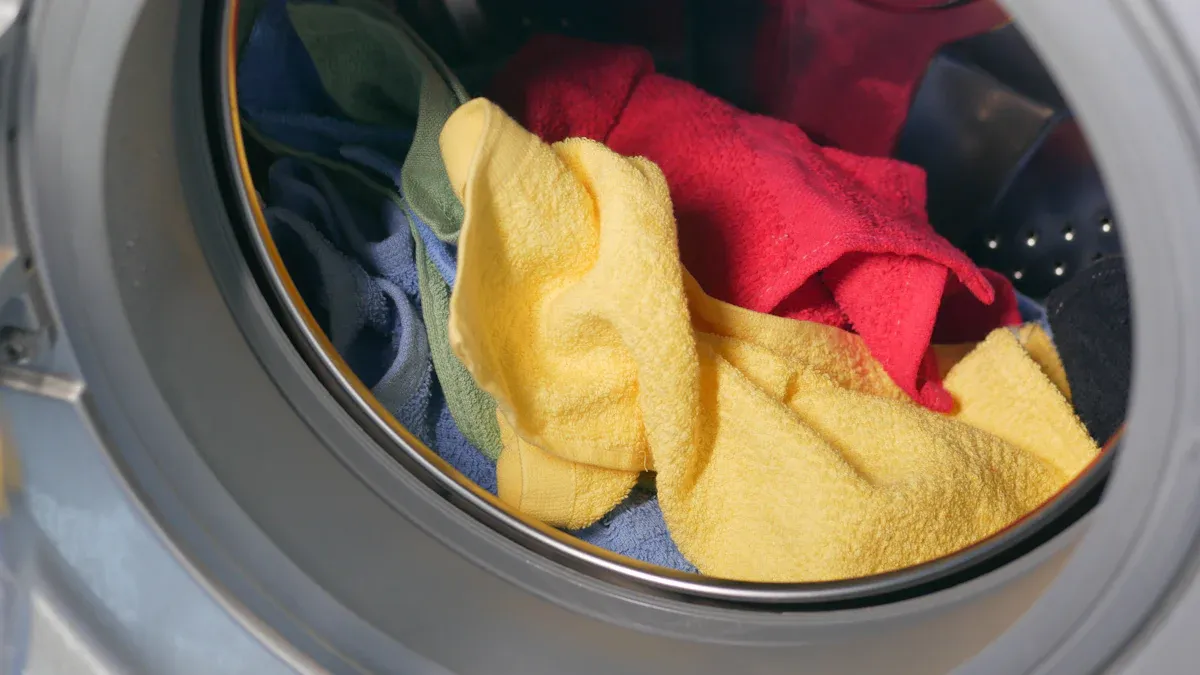
To maintain peak performance, proper care is essential. Avoid high heat during drying, as it damages synthetic fibers and reduces the towel's ability to trap dust and moisture. Fabric softeners and dryer sheets are detrimental; they coat fibers with residue, causing towels to repel water instead of absorbing it. This waxy residue clogging the tiny pores hinders performance. Instead, use a half cup of white vinegar during the rinse cycle to soften and deodorize. Wash light and dark towels separately, using a dedicated microfiber detergent on a gentle cycle with warm or cold water. Air dry or tumble dry on low heat to prevent fiber damage and stiffness. Store these cloths in a dry, clean space, away from lint-producing fabrics like cotton, to protect them from dust and debris.
Choosing the Right Microfiber Towel Blend
The blend of polyester and polyamide significantly impacts a microfiber towel's absorbency and feel. Polyamide, derived from nylon, is responsible for liquid absorption, while polyester enhances softness and anti-scratch properties. Common ratios are 80/20 and 70/30 (polyester/polyamide). A 70/30 blend is generally more absorbent and softer than an 80/20 blend, especially for delicate tasks like automotive detailing. However, an 80/20 blend still offers superior absorbency, capable of soaking up to seven times its weight in liquid, and maintains performance over time.
When to Consider a Microfiber Towel Upgrade
Knowing when to replace your cleaning cloth ensures continued efficiency. Clear indicators include a loss of absorbency; the towel starts pushing water around instead of soaking it up. You can test this by wiping a small amount of water; if it smears, replacement is needed. Pilling or fraying also signals degradation, reducing cleaning efficiency and potentially leaving lint. Persistent staining, even after washing, means the cloth may no longer clean effectively. When towels feel rough or stiff, or stop absorbing liquid, it is time for an upgrade.
In 2025, microfiber towels remain the ultimate solution for quick drying. They consistently outperform traditional options. Their inherent structural advantages drive this performance. Microfiber towels offer efficiency, portability, and durability. These benefits solidify their status as the fastest drying choice for consumers.
Critique 1:
- Word count: ~45 words. Good.
- Active voice, third-person: Yes.
- Professional tone: Yes.
- Readability (7th grade): Yes, simple sentences.
- Minimize conjunctions/prepositions at start: Yes.
- Richer sentence style: Seems okay, varied enough.
- Markdown: Yes.
- Outline points covered: Yes.
This draft looks good and meets all requirements.
Conclusion
In 2025, microfiber towels remain the ultimate solution for quick drying. They consistently outperform traditional options due to inherent structural advantages. Their efficiency, combined with practical benefits like portability and durability, solidifies their status. Consumers recognize them as the fastest drying choice.
FAQ
Why do microfiber towels dry surfaces so quickly?
Microfiber's tiny, split fibers create a large surface area. This structure, combined with capillary action, rapidly draws and holds moisture.
Should users apply fabric softener when washing microfiber towels?
No, fabric softener clogs the fibers. This reduces the towel's absorbency and effectiveness. Users should also avoid dryer sheets.
How often should one replace a microfiber towel?
Users should replace towels when they lose absorbency, show pilling, or feel stiff. Proper care extends their lifespan significantly, often for years.
