

 Send Email
 whatsapp


Microfilament Nonwoven: High Strength, Low Lint, and Excellent Absorbency

Microfilament Nonwoven materials deliver exceptional strength, making them ideal for demanding applications. Their low linting properties maintain cleanliness in sensitive environments, which is crucial for industries like healthcare. Furthermore, the excellent absorbency of these materials, with a water absorption rate reaching up to 438.81% upon modification, significantly enhances functionality in various uses, including microfilament cleaning cloths andmicrofilament nonwoven wipes. Additionally, the versatility of single use non-woven fabrics and microfiber nonwoven fabric makes them suitable for a wide range of applications, while the microfilament nonwoven roll provides convenient options for large-scale use.
Key Takeaways
- Microfilament nonwoven materials offer exceptional strength and low linting, making them ideal for sensitive environments like healthcare and cleanrooms.
- These materials excel in absorbency, capable of soaking up over seven times their weight in water, which enhances their effectiveness in various applications.
- When selecting microfilament nonwoven materials, consider factors like strength, linting levels, and absorbency needs to ensure optimal performance.
Microfilament Nonwoven Structure and Performance

Ultra-Fine Fiber Technology
Microfilament nonwoven materials utilize ultra-fine fiber technology to achieve remarkable performance characteristics. The manufacturing processes, such as melt blowing, convert polymers into continuous filaments. This method employs hot, fast-flowing air to create a self-bonded web of fibers. The resulting filament diameters typically range from 1 to 5 micrometers, significantly finer than those produced by other methods. This fine structure contributes to several key benefits:
- Strength: The smaller diameter fibers enhance tensile strength.
- Flexibility: Ultra-fine fibers provide increased flexibility, allowing for better draping and conformability.
- Filtration Efficiency: The high surface area of these fibers improves filtration capabilities, making them ideal for applications requiring high cleanliness standards.
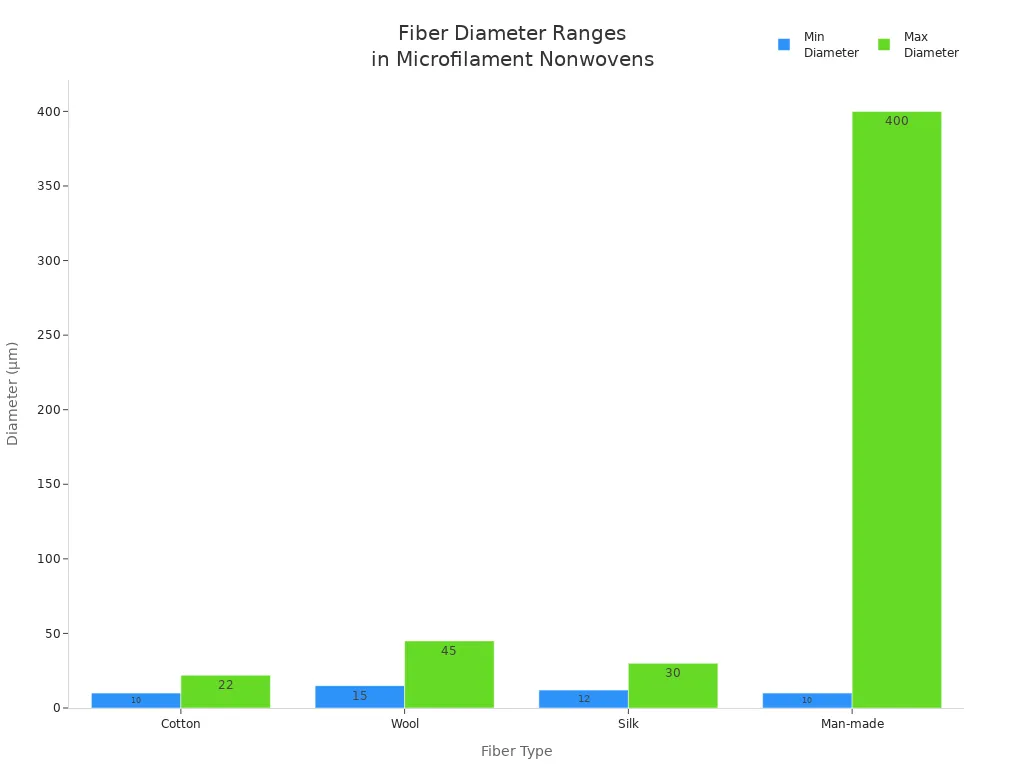
| Fiber Type | Diameter Range (μm) | Denier Range |
|---|---|---|
| Cotton | 10–22 | 1–5 |
| Wool | 15–45 | 2–20 |
| Silk | 12–30 | 1.3–8 |
| Man-made | 10–400 | 1–1000 |
Low Linting Properties
One of the standout features of microfilament nonwoven materials is their low linting properties. These materials produce minimal lint, which is crucial in environments where cleanliness is paramount. Industries such as healthcare and cleanroom applications benefit significantly from this characteristic. The reduced linting ensures that surfaces remain uncontaminated, thus maintaining the integrity of sensitive processes.
Tip: When selecting materials for sensitive environments, prioritize low linting options to enhance cleanliness and reduce contamination risks.
Absorbency Features
Microfilament nonwoven materials excel in absorbency, outperforming many traditional fabrics. These materials can absorb over seven times their weight in water, making them highly effective for various applications. Their drying time is also impressive; they dry in one-third of the time compared to ordinary fibers. The wicking behavior of polyester Microfiber Fabrics surpasses that of standard denier fabrics, ensuring quick moisture removal. This superior absorbency is vital in settings where rapid drying and cleanliness are essential.
- Microfibers demonstrate superior water drop absorbency.
- They exhibit faster drying rates.
- Overall, they provide enhanced total absorbency compared to normal denier fabrics.
Microfilament Nonwoven Applications in Sensitive Environments

Medical and Healthcare Settings
Microfilament nonwoven materials play a crucial role in medical and healthcare settings. Their unique properties significantly enhance infection control and patient safety. For instance, microfiber disposable mop pads achieve approximately 95-98% pathogen removal, which is substantially higher than the 68% achieved by traditional cotton mops. Laboratory studies demonstrate that ultramicrofiber cloths can remove nearly all pathogens, including MRSA and C. difficile spores. The single-use design of these microfiber mops prevents cross-contamination between patient areas, further enhancing infection control measures.
Tip: When selecting cleaning materials for healthcare environments, prioritize those with high pathogen removal rates to ensure patient safety.
Cleanroom Applications
In cleanroom environments, microfilament nonwoven materials meet stringent cleanliness standards. These materials are designed to minimize particle generation and maintain a sterile atmosphere. The following table outlines the key requirements for materials used in cleanroom applications and how microfilament nonwoven materials fulfill these standards:
| Requirement | Description |
|---|---|
| Cleanliness | Must meet IEST Category I particle cleanliness, emitting less than 1200 particles 0.5µm and greater per minute. |
| Electrostatic properties | Treated to manage electrostatic charge, which can affect processes and environments. |
| Durability | Should maintain integrity after sterilization and throughout its useful life. |
| Comfort | Evaluated through Moisture Vapor Transmission Rate (MVTR) for relative comfort. |
| Particle Filtration Efficiency | Ability to filter particles generated by the wearer. |
| Microbial penetration | Prevents microbial penetration and particle contamination. |
| Fluid resistance | Ability to repel water. |
| Chemical resistance/compatibility | Should repel chemicals and be tested against expected exposures. |
Microfilament nonwoven materials excel in these areas, making them ideal for use in cleanrooms where contamination control is paramount.
Food Processing Industry
The food processing industry also benefits from the use of microfilament nonwoven materials. Hygiene and safety regulations necessitate materials that ensure high durability and low lint. These characteristics are essential for maintaining hygiene standards. There is a growing trend towards using engineered wipers over traditional textile rags due to new regulations and increased concerns for worker and product safety. Task-specific wipers have emerged as a reliable solution for efficient cleaning in food processing applications.
- Lightweight nonwovens are increasingly used for wrapping and protection in the food industry.
- Nonwoven inserts commonly absorb liquids in packaging for vegetables, meat, and fruit.
- Knitted net packaging is often utilized for loose fruit and vegetable products.
The demand for sustainable packaging is also rising in the food industry. Nonwoven materials are being adopted for various food packaging applications due to their lightweight properties. This shift reflects a broader trend towards using nonwovens for packaging medicines and electronic parts as well.
Selecting the Right Microfilament Nonwoven
Choosing the right microfilament nonwoven material involves several critical considerations. Each factor plays a significant role in ensuring optimal performance for specific applications.
Considerations for Strength
Strength is a primary consideration when selecting microfilament nonwoven materials. Various mechanical strength tests evaluate these materials for industrial applications. The following table outlines common tests used:
| Test Type | Description |
|---|---|
| Compressive Strength | Measured according to ASTM C39 standards using a specific compression machine. |
| Flexural Strength | Conducted on beam samples as per ASTM C78 standard using a mini-flexural machine. |
| Split Tensile Strength | Explored using the ADR touch SOLO 1500 machine, confirmed by ASTM C496. |
These tests help determine the material's durability and suitability for demanding environments.
Evaluating Linting Levels
Linting levels are crucial in applications where cleanliness is paramount. Several methods assess linting in microfilament nonwoven materials. The table below summarizes these methods:
| Method/Standard | Description |
|---|---|
| ASTM D3511, D5512, D4970 | Tests for pilling or linting in dry state. |
| ISO 9073-10:2003 | Measures lint and particle generation from non-woven fabrics in dry state. |
| ISO 12138:2017 | Specifies domestic laundering procedures for fabrics before flammability testing. |
| Jönsson et al. (2018) | Proposed a six-step standard test for assessing linting levels, including pre-cleaning, cutting, welding, washing, rinsing, and analysis. |
Selecting materials with low linting properties ensures a cleaner environment, especially in sensitive applications.
Assessing Absorbency Needs
Absorbency is another vital factor in material selection. Microfilament nonwoven materials excel in absorbency, making them suitable for various applications. Assessing the specific absorbency needs of an application helps in choosing the right material. Consider factors such as:
- The volume of liquid to be absorbed.
- The speed at which absorbency is required.
- The drying time after use.
By evaluating these aspects, users can select microfilament nonwoven materials that meet their absorbency requirements effectively.
Microfilament nonwoven materials are essential for industries requiring high performance and cleanliness. They have proven beneficial in sectors such as automotive and healthcare, where their unique properties enhance operational efficiency.
- Versatile Applications: Microfilament nonwoven materials find use in various sectors, including:
| Application Sector |
|---|
| Transport Textiles |
| Medical and Hygiene Textiles |
| Industrial Products and Components |
| Agriculture, Horticulture, and Fishing |
| Home Textiles |
| Clothing Components |
| Packaging and Containment |
| Construction – Building and Roofing |
| Geotextiles in Civil Engineering |
| Sport and Leisure |
| Protective and Safety Clothing or Textiles |
| Ecological Protection Textiles |
Understanding the benefits of microfilament nonwoven materials can lead to better material selection and improved outcomes across diverse applications.
FAQ
What are microfilament nonwoven materials?
Microfilament nonwoven materials consist of ultra-fine fibers, providing high strength, low linting, and excellent absorbency for various applications.
How do microfilament nonwoven materials compare to traditional fabrics?
Microfilament nonwoven materials outperform traditional fabrics in strength, absorbency, and cleanliness, making them ideal for sensitive environments.
Are microfilament nonwoven materials environmentally friendly?
Many microfilament nonwoven materials are recyclable and designed for sustainability, reducing environmental impact compared to conventional textiles.
