

 Send Email
 whatsapp


What are the requirements for healthcare curtains?
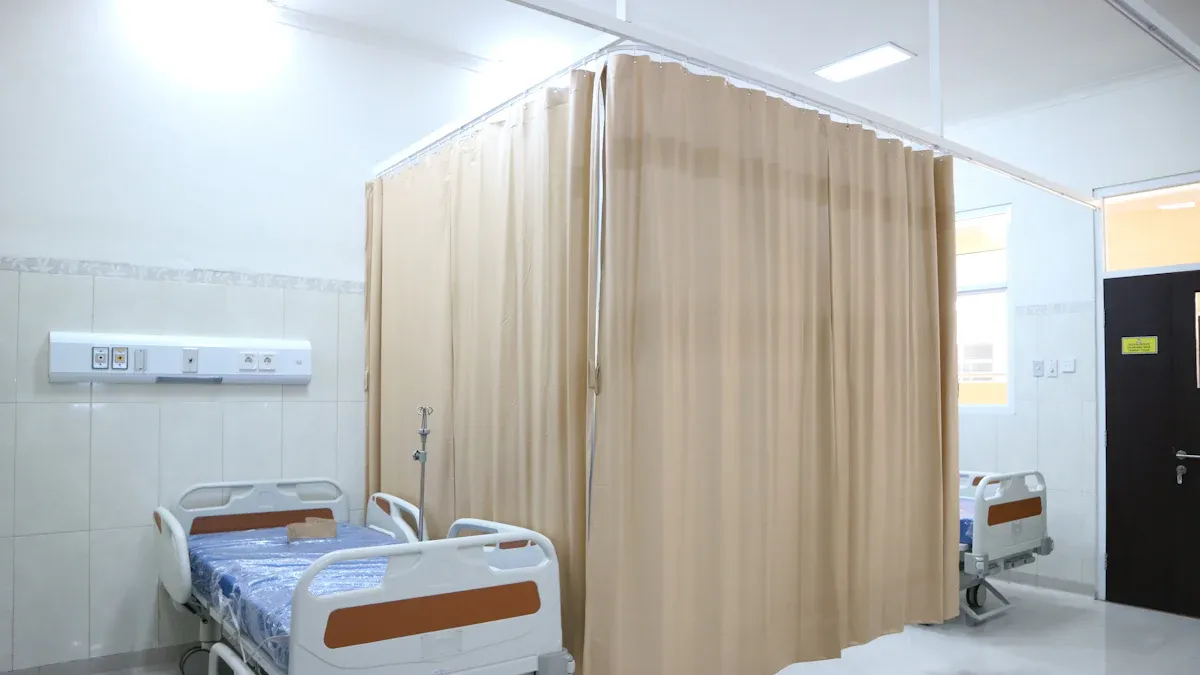
Healthcare environments demand strict attention to safety and hygiene. A hospital curtain must resist fire, limit infection spread, and provide reliable privacy. Many facilities now prefer disposable hospital curtains for enhanced cleanliness. Every hospital partition curtain requires regular assessment to maintain both durability and compliance with healthcare regulations.
Key Takeaways
- Healthcare curtains must meet strict fire safety and antimicrobial standards to protect patients and staff from fire risks and infections.
- Regular cleaning, inspection, and timely replacement of curtains ensure they remain effective, safe, and compliant with healthcare regulations.
- Curtains should provide full privacy with durable, approved materials and be installed properly using reliable track systems for smooth and safe operation.
Safety and Hygiene Requirements for Hospital Curtain

Fire Retardancy Standards
Fire safety remains a top priority in healthcare environments. Hospitals require curtains that meet rigorous fire retardancy standards to protect patients and staff.
- BS 5867-2 Type C sets the highest benchmark for fire resistance in hospital curtains. Fabrics must withstand 50 washing cycles at 75°C, including tumble drying, without losing their flame-retardant properties.
- Testing involves applying a vertical flame and measuring after-flame and afterglow times. Curtains pass if flames do not reach the fabric edges and no flaming debris falls.
- In the United States, NFPA 701-certified curtains self-extinguish within two seconds and limit flame spread to four inches or less. The test exposes the curtain to a 1.5-inch flame for 12 seconds.
- NYU Langone Health retrofitted 8,000 rooms with NFPA 701-certified curtains, resulting in a 60% reduction in fire risks.
- EU Euroclass B-s1,d0 fabrics emit minimal smoke and no flaming droplets, which is crucial for sensitive hospital areas.
- Inherently flame-retardant polyester fabrics maintain their properties throughout the fabric's lifespan. Chemically treated fabrics require re-treatment every five years.
A hospital curtain that meets these standards ensures a safer environment and long-term compliance.
Compliance with Local Codes and Regulations
Hospitals must follow local, state, and national codes when selecting and installing curtains. Regulatory bodies such as the Joint Commission, Centers for Medicare & Medicaid Services (CMS), and local fire marshals set specific requirements for healthcare facilities.
Facilities should regularly review updates to these codes to maintain compliance and avoid penalties.
Curtains must display proper labeling, including fire rating and manufacturer information. Documentation of compliance supports facility audits and inspections. Hospitals that fail to comply risk fines, operational disruptions, and increased liability.
Antimicrobial Properties and FDA Clearance
Hospital curtains often serve as high-touch surfaces, making antimicrobial protection essential. Manufacturers use advanced textiles and coatings to reduce the risk of pathogen transmission. The following table summarizes key performance data for antimicrobial hospital curtain fabrics:
| Aspect | Quantitative Details |
|---|---|
| Target bacteria | Staphylococcus aureus, Pseudomonas aeruginosa |
| Control carrier count level | 4.0 to 5.5 log CFU/carrier |
| Performance standard | Minimum mean 4.0-log reduction in ≤10 minutes |
| Microbial reduction | >99.999% (>5 log10) against Gram-positive and Gram-negative bacteria and fungi |
| Durability test | Up to 100 wash/dry cycles |
| Safety | Non-irritating and hypoallergenic (third-party dermatological tests) |
FDA clearance confirms that antimicrobial agents used in hospital curtain fabrics meet safety and efficacy standards. Manufacturers must provide evidence of compatibility with cleaning agents and physical durability. Hospitals should select curtains with proven antimicrobial performance to support infection control protocols.
Cleanability, Laundering, and Disinfection Protocols
Routine cleaning and disinfection extend the life of a hospital curtain and reduce infection risks. Facilities should follow manufacturer guidelines for laundering temperature, cycle frequency, and compatible disinfectants.
- Inherently flame-retardant and antimicrobial fabrics withstand repeated washing and drying without losing effectiveness.
- Disposable curtains offer a practical solution for high-turnover areas, as staff can replace them quickly after patient discharge or contamination.
- Facilities should document cleaning schedules and protocols to demonstrate compliance during inspections.
A well-maintained hospital curtain supports a safe, hygienic, and compliant healthcare environment.
Privacy, Material, and Installation Standards for Hospital Curtain
Opacity and Privacy Coverage
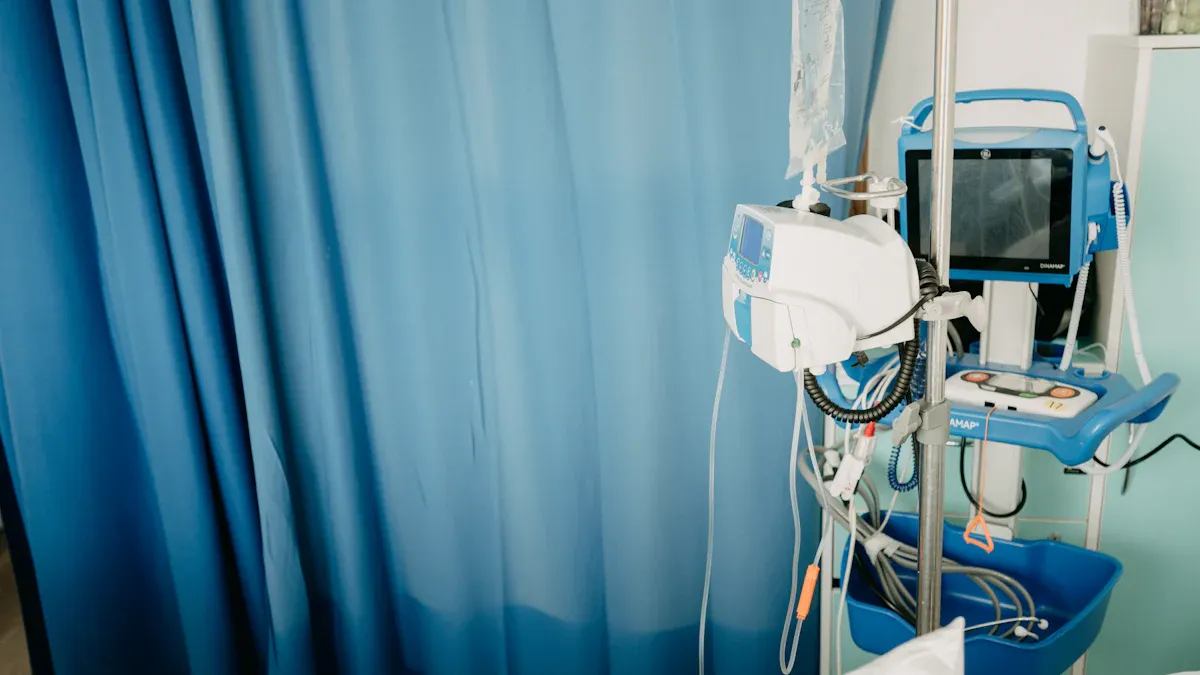
A hospital curtain must guarantee complete privacy for patients. The fabric should block visibility from all angles, even in brightly lit rooms. Designers often select tightly woven textiles or multi-layered materials to prevent silhouettes and shadows from appearing.
Privacy coverage extends from the ceiling to just above the floor, leaving a small gap for cleaning equipment and airflow.
Healthcare staff rely on these curtains to create a secure and confidential environment during examinations, treatments, and personal care. Facilities should regularly check for worn or transparent areas that could compromise privacy.
Approved Materials and Durability
Manufacturers use only approved materials for hospital curtain production. Polyester and polyester blends dominate the market due to their strength, flame resistance, and ease of cleaning. Some facilities choose fabrics with specialized coatings that provide antimicrobial protection and resist stains.
- Antibacterial efficacy remains high against common pathogens such as Staphylococcus aureus, Pseudomonas aeruginosa, and Acinetobacter baumannii. BASF-coated curtains show excellent to moderate activity, while some commercial coatings offer less protection.
- Antibacterial activity does not decline after six months of storage, which demonstrates the durability of the coating.
- Abrasion resistance testing with the Martindale method simulates strong textile forces. After 1,000 cycles, only limited weight loss occurs, though scanning electron microscopy (SEM) reveals minor fiber-level damage.
- Artificial aging tests simulate real hospital use by moving the curtain repeatedly over periods equivalent to two weeks, three months, and five years. Gravimetric analysis and SEM imaging after these tests show minimal fabric and coating degradation.
- SEM imaging confirms that coatings remain evenly distributed on the textile, even after abrasion and aging. No visible deposits or crystal-like structures appear.
- Mechanical stability tests combine weight loss measurements and SEM imaging to assess textile integrity and coating retention under worst-case scenarios.
These results confirm that modern hospital curtain materials can withstand years of daily use while maintaining their protective properties.
Track Systems and Proper Installation
A hospital curtain requires a reliable track system for smooth operation and safety. Aluminum and stainless steel tracks resist corrosion and support the weight of heavy fabrics. Installers must ensure that tracks run parallel to the ceiling and do not sag or bend under load.
- Ceiling-mounted tracks maximize privacy and allow for full enclosure of patient spaces.
- Cubicle Curtain tracks often include breakaway features for emergency access.
- End stops and carriers prevent curtains from slipping off the track.
- Installers must follow manufacturer guidelines for spacing, anchoring, and hardware selection.
Proper installation reduces the risk of accidents and ensures that staff can quickly open or close the curtain as needed.
Routine Inspection and Replacement Guidelines
Routine inspection keeps every hospital curtain in optimal condition. Facility managers should create a checklist for regular visual inspections, focusing on:
- Tears, holes, or fraying along seams and edges
- Stains or discoloration that do not wash out
- Loss of flame-retardant or antimicrobial labeling
- Track alignment and hardware integrity
Tip: Replace curtains immediately if they show signs of damage, contamination, or loss of protective properties.
Most manufacturers recommend replacing reusable curtains every 6 to 12 months, depending on usage and laundering frequency. Disposable curtains should be changed after each patient discharge or when visibly soiled. Documenting inspection and replacement schedules helps facilities maintain compliance and ensures a safe, private environment for patients.
Adhering to strict requirements for healthcare curtains ensures safer, cleaner, and more private patient environments.
- Infection prevention and control practices reduce healthcare-associated infections, which affect 1 in 31 patients daily and cost billions annually.
- Joint Commission standards guide facilities in maintaining effective safety and infection control measures.
FAQ
What is the recommended replacement schedule for hospital curtains?
Most manufacturers suggest replacing reusable curtains every 6 to 12 months. Disposable curtains should be changed after each patient discharge or when visibly soiled.
Do hospital curtains require special cleaning products?
Facilities should use cleaning agents approved by the curtain manufacturer. These products help maintain antimicrobial and flame-retardant properties.
Are disposable hospital curtains as safe as reusable ones?
Disposable curtains meet the same fire safety and antimicrobial standards as reusable options. Staff can replace them quickly, which supports infection control protocols.
