

 Send Email
 whatsapp


Microfiber Cleaning Cloth Buying Guide What to Look for in Quality and Durability in 2025

A quality Microfiber Cleaning Cloth ensures superior cleaning results. Investing in durable microfiber ragsalso promotes environmental sustainability. Reusable Wiping Rags, such as a high-grademicrofiber towel, significantly reduce landfill waste. This choice demonstrates a commitment to smart economics. A quick dry microfiber towel or a specialized car cleaning microfiber towel provides lasting efficiency.
Key Takeaways
- Microfiber Cloths clean better than old cleaning materials. They use tiny fibers topick up dirt and germs.
- Microfiber cloths soak up a lot of liquid. They can hold seven times their weight in water.
- A higher GSM number means a thicker and stronger microfiber cloth. This makes it better at cleaning and lasts longer.
Understanding Your Microfiber Cleaning Cloth

What is a Microfiber Cleaning Cloth?
A Microfiber Cleaning Cloth represents a significant advancement in cleaning technology. Manufacturers create these cloths from synthetic fibers, primarily polyester and polyamide. The fibers possess an incredibly fine diameter, approximately 1/10th the thickness of a human hair. This microscopic size allows the cloth to reach and clean even the smallest crevices effectively. This unique construction differentiatesmicrofiber from traditional cleaning materials.
Core Benefits of Microfiber Cleaning Cloths
The unique structure of microfiber provides numerous advantages for cleaning tasks. Its ultra-fine fibers create an enormous surface area. During production, these fibers split, forming a web-like structure with millions of microscopic hooks and crevices. These tiny spaces act like magnets, trapping dust, dirt, grease, and bacteria rather than just spreading them around. This prevents contaminants from merely being pushed across surfaces.
Microfiber's absorbency also stands out. Capillary action allows it to soak up to seven times its weight in liquid. This principle ensures efficient absorption of spills and wet substances. The microscopic scale of the fibers enables the fabric to penetrate tiny crevices, trapping particles more effectively than traditional materials. This high absorbency ensures efficient sequestration and retention of liquids, grime, and stains. These characteristics make a Microfiber Cleaning Cloth highly efficient for various cleaning applications.
Key Quality Indicators for a Microfiber Cleaning Cloth in 2025
Grams Per Square Meter (GSM) for Microfiber Cleaning Cloths
Grams Per Square Meter, or GSM, serves as a critical indicator of a microfiber cleaning cloth's quality. This measurement quantifies the fabric's density and thickness. A higher GSM generally signifies a denser, thicker fabric. This density directly influences the cloth's absorbency and its ability to withstand repeated use. For instance, cloths with 300-400 GSM offer greater thickness, enhanced softness, and superior water retention. Those exceeding 400 GSM provide extreme absorbency and a plush feel. Conversely, lower GSM cloths, typically below 200, exhibit less absorbency and durability, making them suitable for more disposable applications. Mid-range cloths, between 200-300 GSM, strike a balance between performance and cost. High GSM cloths, ranging from 350-500, excel in tasks demanding both high absorbency and robust durability.
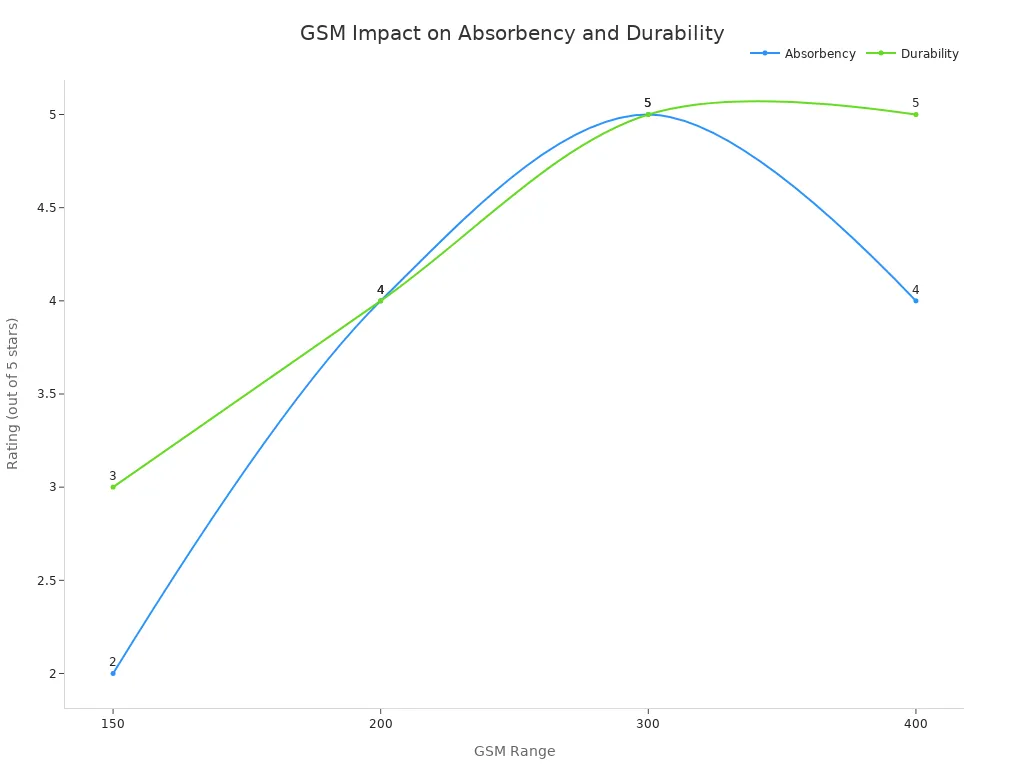
The GSM rating directly impacts a microfiber cloth's absorbency and durability. Observe the general trends:
| GSM Range | Absorbency | Durability |
|---|---|---|
| 150 | ★★☆☆☆ | ★★★☆☆ |
| 200 | ★★★★☆ | ★★★★☆ |
| 300 | ★★★★★ | ★★★★★ |
| 400 | ★★★★☆ | ★★★★★ |
Absorbency typically increases with GSM, reaching its peak between 250–300 GSM. Durability consistently improves as GSM increases, showing significant gains above 200 GSM.
Optimal GSM for Various Microfiber Cleaning Cloth Tasks
Different cleaning tasks benefit from specific GSM ranges. For general cleaning tasks, a high-quality microfiber cleaning cloth typically falls within the 250–350 GSM range. This medium-weight category provides an excellent balance of softness, scrubbing power, and absorbency, making it ideal for daily operations and multipurpose surface applications.
Automotive detailing requires specific GSM considerations. The recommended GSM range for microfiber cloths in this application is usually between 300 and 400. This range offers an optimal balance of absorbency and softness, suitable for most detailing needs.
| Microfiber Cloth Type | Recommended GSM Range |
|---|---|
| All-Purpose Terry | 200-350 |
| Dual Pile | 300-450 |
| Super Plush | Higher than 400 |
| Waffle Weave | 200-500 |
For streak-free glass cleaning, specific GSM values prove highly effective. Towels with a GSM of 350, like the 'Perfect Glass' towel, are specifically engineered for achieving lint-free and streak-free results on glass. Similarly, a 450 GSM towel, such as Adam's Glass Cleaning towel, guarantees streak-free glass cleaning.
Microfiber Cleaning Cloth Blend Ratios: Polyester and Polyamide
The performance of a microfiber cloth also depends heavily on its blend ratio of polyester and polyamide. Each component contributes distinct properties.
Polyester microfiber offers exceptional durability and resistance to wear and tear. Its tightly woven fibers resist fraying and tearing, ensuring the cloth maintains its form through frequent use and multiple washes. This contributes to a long lifespan. Polyester also provides practical benefits such as stain resistance, wrinkle resistance, and excellent color retention, simplifying maintenance. Its low absorbency allows for quick drying, further enhancing ease of care. Polyester's fine fibers, often wedge-shaped with small channels, increase surface area. This structure allows the cloth to effectively trap and hold dirt, dust, and liquid. These fine fibers act like tiny hooks, grabbing and lifting away contaminants. Tightly woven polyester fibers also create an environment less hospitable to bacteria, contributing to antimicrobial properties.
Polyamide significantly enhances both the softness and absorbency of microfiber cleaning cloths. A higher percentage of polyamide generally results in a softer and more absorbent towel. This is why premium microfiber towels often feature a greater proportion of polyamide. Polyamide makes the fabric softer, which helps prevent scratches on delicate surfaces like car paint. It also increases the cloth's capacity to absorb and retain water, making it highly effective for drying and detailing tasks without leaving streaks. In contrast, cloths made from 100% polyester tend to be rougher and less absorbent.
Ideal Blend Ratios for Microfiber Cleaning Cloth Performance
The ideal blend ratio of polyester to polyamide varies depending on the intended cleaning task. For all-purpose cleaning, an 80% polyester and 20% polyamide blend is frequently used. This 80/20 ratio provides durability across a wide range of tasks, from bath and tile cleaning to dusting, glass, grease, and stainless steel applications. Polyester, being the stronger fiber, consistently forms the higher percentage in these blends. While a higher polyamide content can make a cloth visibly thicker and softer, this textural difference does not always significantly enhance cleaning performance for general use.
For polishing delicate surfaces without scratching, a different blend ratio is optimal. Towels designed for buffing delicate surfaces typically feature a 70/30 polyester to polyamide ratio. This blend is considered the industry standard for balancing cleaning power with softness. A revolutionary anti-static spun blend of 70% polyester and 30% polyamide fabric is perfect for use even on the softest paint. This higher polyamide ratio makes the microfiber softer and more absorbent, making it ideal for delicate surfaces like glass, mirrors, screens, or automotive paint, ensuring streak-free and lint-free results.
Durability Features of a Quality Microfiber Cleaning Cloth
A high-quality microfiber cleaning cloth offers more than just superior cleaning; it also provides exceptional durability. Understanding the features that contribute to a cloth's longevity helps consumers make informed purchasing decisions. These features include the quality of edging and stitching, the type of weave, and its resistance to linting and pilling.
Edging and Stitching Quality of Microfiber Cleaning Cloths
The edging and stitching of a microfiber cloth significantly impact its lifespan and performance. Professionals highly recommend the hemmed edge method for its durability and non-scratching properties. This process involves folding the edges over and stitching them shut, which leads to a longer-lasting towel. Another method, the piped or banded edge, involves stitching strips of cloth along the edges. This creates softer edges and a more premium feel, contributing to overall quality.
Conversely, edgeless towels, while excellent for buffing and polishing due to reduced scratch risk, are prone to fraying over time, indicating a shorter lifespan. The serged or overlocked edge is a cost-effective method. It wraps edges in extra thread to prevent fraying, but it does not offer a premium feel. Manufacturers typically use this method in budget products. Double-stitching around the edges is a key feature in the manufacturing of high-quality microfiber cloths. It significantly contributes to maintaining their structural integrity and extending their lifespan. Microfiber cloths with single-stitched or entirely unstitched edges are typically of lower quality. Manufacturers make them from less durable materials, resulting in a significantly shorter effective life, sometimes as brief as 50 washes.
Comparing ultrasonic (edgeless) edging with stitched edging reveals distinct advantages and disadvantages for each:
| Feature | Ultrasonic (Edgeless) Edging | Stitched Edging |
|---|---|---|
| Durability | Can fray if washed poorly; generally lasts shorter than edged towels | Higher, less fraying; generally lasts longer because stitching prevents fraying |
| Scratch Prevention | Highest safety on paint; no seams or edges to scratch; ultra-safe for sensitive paint and high-gloss surfaces | Moderate safety; edges can potentially scratch paint if stitching is rough; not ideal for delicate surfaces like piano black trim or freshly polished paint |
| Pros | Ultra-safe for sensitive paint and high-gloss surfaces; no stitched seams to scratch or drag | More durable, resisting fraying over time |
| Cons | May fray faster over time if washed incorrectly | Edges can potentially scratch paint if the stitching is rough; not ideal for delicate surfaces |
Edgeless towels have no extra material, piping, or yarn on the side to scratch surfaces. This makes them a sought-after pick for auto detailers. The absence of an edge to sew the label also eliminates labels, which detailers often remove to prevent scratching fine surfaces. However, even though the minimal heat from the knife blades heat-seals the edges to prevent fraying, aggressive usage can still lead to some fraying. Also, higher GSM towels are harder to ultrasonically cut, sometimes resulting in a rough edge due to extended heat application.
Weave Types for Microfiber Cleaning Cloth Applications
The weave type of a microfiber cloth dictates its effectiveness for various cleaning tasks and its overall durability. Different weaves are engineered to excel in specific applications. For instance, a waffle weave excels in absorbency, making it ideal for drying surfaces quickly. Terry weaves offer a good balance of absorbency and scrubbing power, suitable for general cleaning. Plush weaves provide maximum softness, perfect for delicate surfaces that require gentle treatment.
Nonwoven cleaning wipes are explicitly ideal for routinely cleaning sensitive electronic equipment, including screens. Their lint-free nature and ability to safely remove dust, fine particles, and other residues without leaving behind fibers or impurities make them highly effective. These wipes are safe for electronic surfaces, low-lint, and highly absorbent. They effectively clean surfaces without leaving behind pesky fibers and impurities, making them perfect for use on glass, lenses, and more. They are also durable and ultra-soft, protecting sensitive surfaces, quickly lifting away everyday contaminants, and holding up to the toughest jobs.
Linting and Pilling Resistance in Microfiber Cleaning Cloths
Linting and pilling can diminish a microfiber cloth's effectiveness and appearance. High-quality microfiber cloths are manufactured using processes that minimize these issues. Spunlace technology is a high-tech manufacturing process that uses water jets to entangle microfibers. This creates a strong, flexible fabric without chemicals or adhesives. Hydroentanglement also uses high-pressure water jets to interlock fibers, forming a dense, uniform structure that resists tearing and fraying, thus eliminating loose fibers. A tight weave and split microfibers also prevent loose fibers. Each microfiber is split into 8-10 'petal' strands, increasing surface area for better dirt capture and lint elimination. These advanced manufacturing techniques ensure the cloth remains effective and aesthetically pleasing throughout its lifespan.
Choosing the Right Microfiber Cleaning Cloth for Specific Tasks

Selecting the correct microfiber cloth for a task optimizes cleaning efficiency and protects surfaces. Different applications require specific characteristics in weave, GSM, and blend.
Microfiber Cleaning Cloths for Glass and Mirrors
For achieving streak-free results on glass and mirrors, specific microfiber cloths are highly effective. These cloths feature unique weave patterns and optimal GSM ratings.
| Weave Pattern | GSM | Recommended for Streak-Free Cleaning |
|---|---|---|
| Pearl Weave | 300 | Yes |
| Silky Microfiber | 290 | Yes (implied as a 'Glass Towel') |
| Waffle Weave | 360-380 | Yes (implied as a 'Glass Towel') |
| Waffle Weave | 380 | Yes (implied as a 'Glass Towel') |
| These specialized weaves ensure surfaces remain clear, lint-free, and polished. |
General Purpose Microfiber Cleaning Cloths
A versatile general-purpose microfiber cleaning cloth balances absorbency, softness, and durability. The blend ratio of polyester and polyamide is crucial for its performance. Polyester contributes to the cleaning ability. Polyamide enhances softness and absorbency.
| Characteristic | General Cleaning | Heavy-Duty Cleaning |
|---|---|---|
| GSM | 300 or higher | Up to 600 |
| Blend Ratio (Polyester/Polyamide) | 80/20 (good balance of absorbency, softness, durability) | 70/30 (softer, more absorbent, but may wear faster) |
| An 80/20 blend with 300 GSM or higher offers excellent performance for daily cleaning tasks. |
Heavy-Duty and Absorbent Microfiber Cleaning Cloths
For large liquid spills and tough messes, highly absorbent microfiber cloths are essential. These cloths feature extremely thin synthetic fibers. This construction contributes to their high absorbency. They effectively wipe up spills and pull up grease and dirt, reducing the need for chemical cleaners. Such cloths are:
- Highly absorbent
- Quick drying
- Super fluffy with a touch of velvet for a gentler feel
- Thicker material, suitable for soaking up water
- Long-lasting and tackle heavy-duty messes
Specialized Microfiber Cleaning Cloths for Delicate Surfaces
Delicate surfaces require specific microfiber cloths to prevent scratches. These cloths are ideal for items like musical instruments or camera lenses. They feature:
- Untreated high-quality cloth
- Ultrafine microfiber material
- Soft and lint-free fabric
- Ensures scratch-free cleaning and polishing
- Removes dust, fingerprints, smudges, and grime
- Preserves the instrument's finish These specialized cloths protect sensitive finishes while effectively cleaning.
Extending the Lifespan of Your Microfiber Cleaning Cloth
Proper care significantly extends the lifespan of cleaning cloths, maintaining their effectiveness. Adhering to specific washing and drying techniques preserves their unique properties.
Proper Washing Techniques for Microfiber Cleaning Cloths
Washing microfiber cloths correctly ensures they remain highly absorbent and durable. For machine washing, a recommended temperature setting is typically 104°F (40°C). This temperature helps maintain the integrity of the fibers. One should use warm or cold water for washing, not exceeding 140°F (60°C). A lower temperature setting on the washing machine helps preserve the integrity of these cloths. When selecting a detergent, choose options free of dyes, perfumes, parabens, and other common skin allergens. Examples include ARM & HAMMER™ Free & Clear Liquid Laundry Detergent, ARM & HAMMER™ Sensitive Skin Plus Hypoallergenic Fresh Scent Liquid Laundry Detergent, or ARM & HAMMER™ Clean & Simple Liquid Laundry Detergent. These gentle detergents ensure effective cleaning without damaging the delicate fibers.
Correct Drying Methods for Microfiber Cleaning Cloths
Proper drying methods are crucial for preserving the absorbency and softness of microfiber cloths. Air drying is highly recommended to maintain their integrity. If using a dryer, tumble dry on low heat. High heat can damage the delicate fibers, leading to a loss of absorbency and softness.
What to Avoid When Caring for Microfiber Cleaning Cloths
Certain practices can significantly reduce the effectiveness and lifespan of microfiber cloths. Avoid washing with hot water, as it can damage, shrink, or melt the synthetic fibers, leading to a loss of softness and absorbency. Hot water can also cause dye discoloration. Do not use fabric softeners or dryer sheets. Their waxes and chemicals coat the fibers, making them repel water instead of absorbing it, which reduces cleaning effectiveness. Generally, avoid bleach for routine washing because its high alkalinity degrades fibers, causing fraying and reduced absorbency. Use it only occasionally for extremely dirty towels, and rinse thoroughly. Finally, do not dry microfiber on high heat settings. This can melt, shrink, and damage the fibers. Instead, use the lowest heat setting, no heat, or air fluff, or line dry.
Future Trends for Microfiber Cleaning Cloths in 2025
The cleaning industry continually evolves. Microfiber technology also advances, focusing on sustainability, enhanced performance, and hygiene. Manufacturers develop innovative solutions to meet growing consumer demands.
Sustainable Microfiber Cleaning Cloth Options
Sustainability drives significant innovation in cleaning products. Companies actively seek ways to reduce environmental impact. For example, ABENA, in collaboration with Nordisk Microfiber (NMF), introduced the TAKE BACK recycling system. This system collects worn-out cloths and mops. It then breaks them down into an industrial roll, which can replace paper in various applications. This process increases circularity and extends product lifetime. Furthermore, advanced recycling processes now convert post-consumer plastics into high-quality microfibers. This reduces waste and lessens reliance on virgin resources. Hybrid fiber technologies also emerge, combining natural and synthetic polymers. These include recycled polyester with biodegradable additives, creating more environmentally friendly options.
Advanced Weave Technologies for Microfiber Cleaning Cloths
Future microfiber cloths will feature even more sophisticated weave patterns. These advancements aim to optimize cleaning efficiency and durability. Expect specialized weaves that enhance particle capture, reduce friction, and improve drying times. Innovations will likely focus on creating multi-layered structures. These structures offer superior absorption and scrubbing power without compromising surface safety.
Anti-Bacterial and Odor-Resistant Microfiber Cleaning Cloths
Hygiene remains a top priority. Manufacturers integrate antimicrobial agents directly into cloth fibers. These agents prevent bacterial growth. Specific inorganic antimicrobial agents include silver (Ag), copper (Cu), and zinc (Zn). Silver disrupts bacterial cell membranes. Copper damages proteins and DNA. Zinc interferes with bacterial metabolism. Some premium cloths also feature long-lasting disinfectant agents. These agents leave surfaces free from microorganisms. Odor-resistant treatments, such as AEGIS® technology, neutralize smells. This technology punctures the cell membranes of bacteria and fungi upon contact. It prevents their growth and reproduction, which are common causes of unpleasant odors. This treatment offers permanent protection against odors, staining, and product degradation, even after numerous washes.
Selecting a high-quality, durable Microfiber Cleaning Cloth requires evaluating GSM, blend ratios, and construction. These insights empower informed purchasing decisions for lasting cleaning efficiency. Anticipate future advancements in sustainable and technologically enhanced cleaning solutions.
FAQ
What does GSM indicate in microfiber cloths?
GSM, or Grams Per Square Meter, measures a microfiber cloth's density and thickness. Higher GSM generally means a thicker, more absorbent, and more durable cloth.
Which blend ratio is best for all-purpose cleaning?
An 80% polyester and 20% polyamide blend is ideal for general cleaning. This ratio provides excellent durability and effective cleaning across various surfaces.
How should one properly wash microfiber cloths?
- Wash with warm or cold water (under 140°F/60°C).
- Use a detergent free of dyes and perfumes.
- Avoid fabric softeners and bleach.
- Air dry or tumble dry on low heat.
